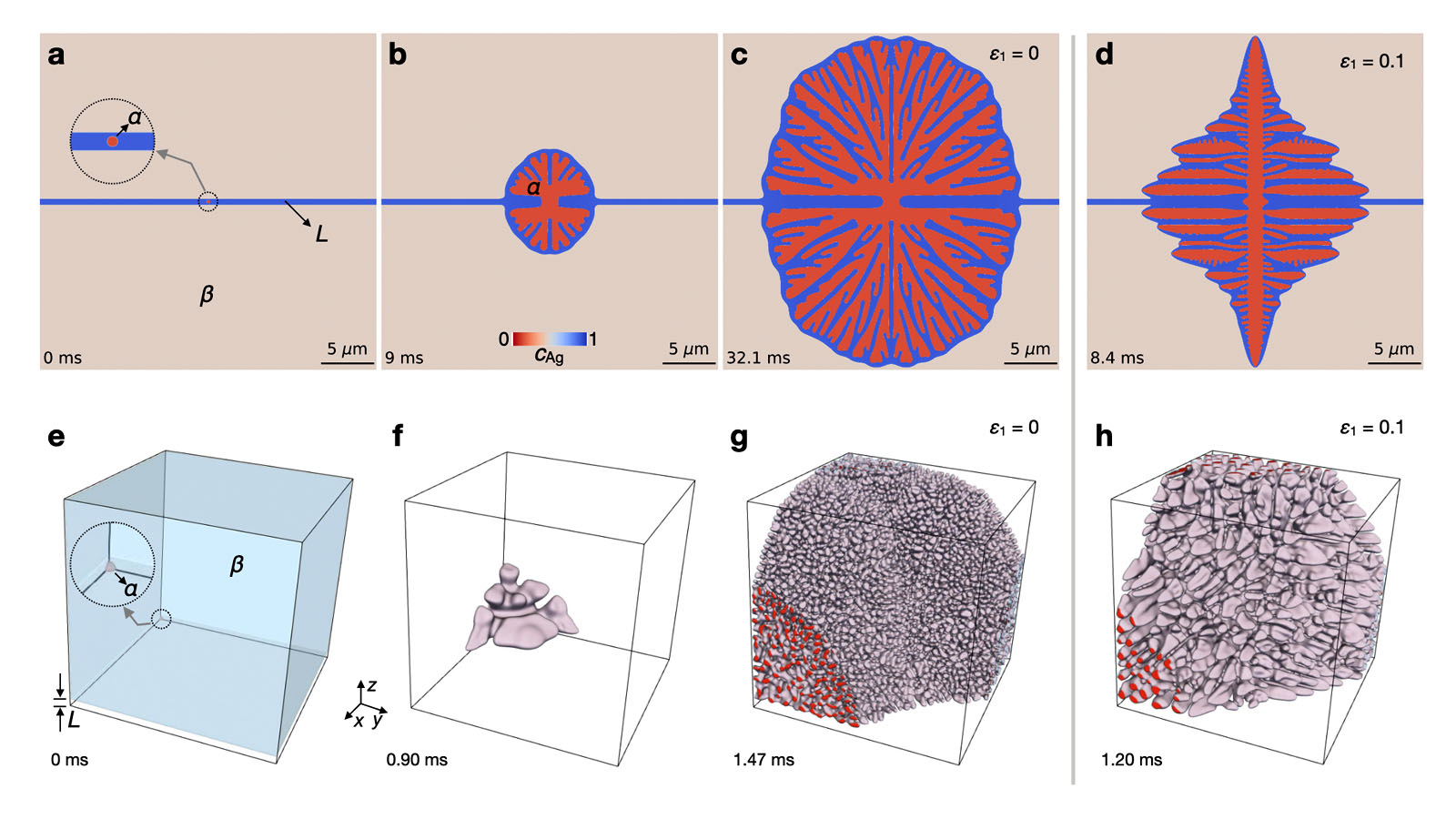
Bicontinuous materials, which contain interconnected networks of two distinct phases, are valuable for applications ranging from energy storage and catalysis to sensing and advanced manufacturing. While several dealloying techniques can create these structures, scientists have struggled to explain how bicontinuous architectures emerge during peritectic melting, a process in which an alloy melts and reorganizes internally without an external chemical bath. Experimental studies of titanium-silver (Ti-Ag) alloys had observed the formation of these intricate structures, but the underlying mechanism remained unknown.
Using large-scale phase-field simulations, Northeastern researchers uncovered the physical process responsible. The team showed that a thin liquid layer formed during melting becomes morphologically unstable, causing a titanium-rich phase to grow into complex branched structures. As neighboring branches expand, they merge and form interconnected "handles," gradually transforming the material into a highly connected bicontinuous network. Their simulations also revealed fundamental scaling laws that govern how quickly these structures form and how their characteristic dimensions evolve over time. The researchers validated these observations with a new theoretical framework that accurately predicts the behavior seen in the simulations.
The discovery establishes peritectic melting as a fundamentally distinct pathway for creating bicontinuous materials and provides new principles for controlling microstructure during alloy processing. By showing how grain size and ligament size can be independently tuned, the work could help accelerate the design of next-generation materials for batteries, catalysts, structural components, and other energy-related technologies.
Northeastern's research computing infrastructure was essential to the effort, enabling demanding three-dimensional simulations and topological analyses that revealed mechanisms impossible to observe directly in experiments.
Zhong, M., & Karma, A. (2026), Dealloying by peritectic melting, arXiv:2605.25834