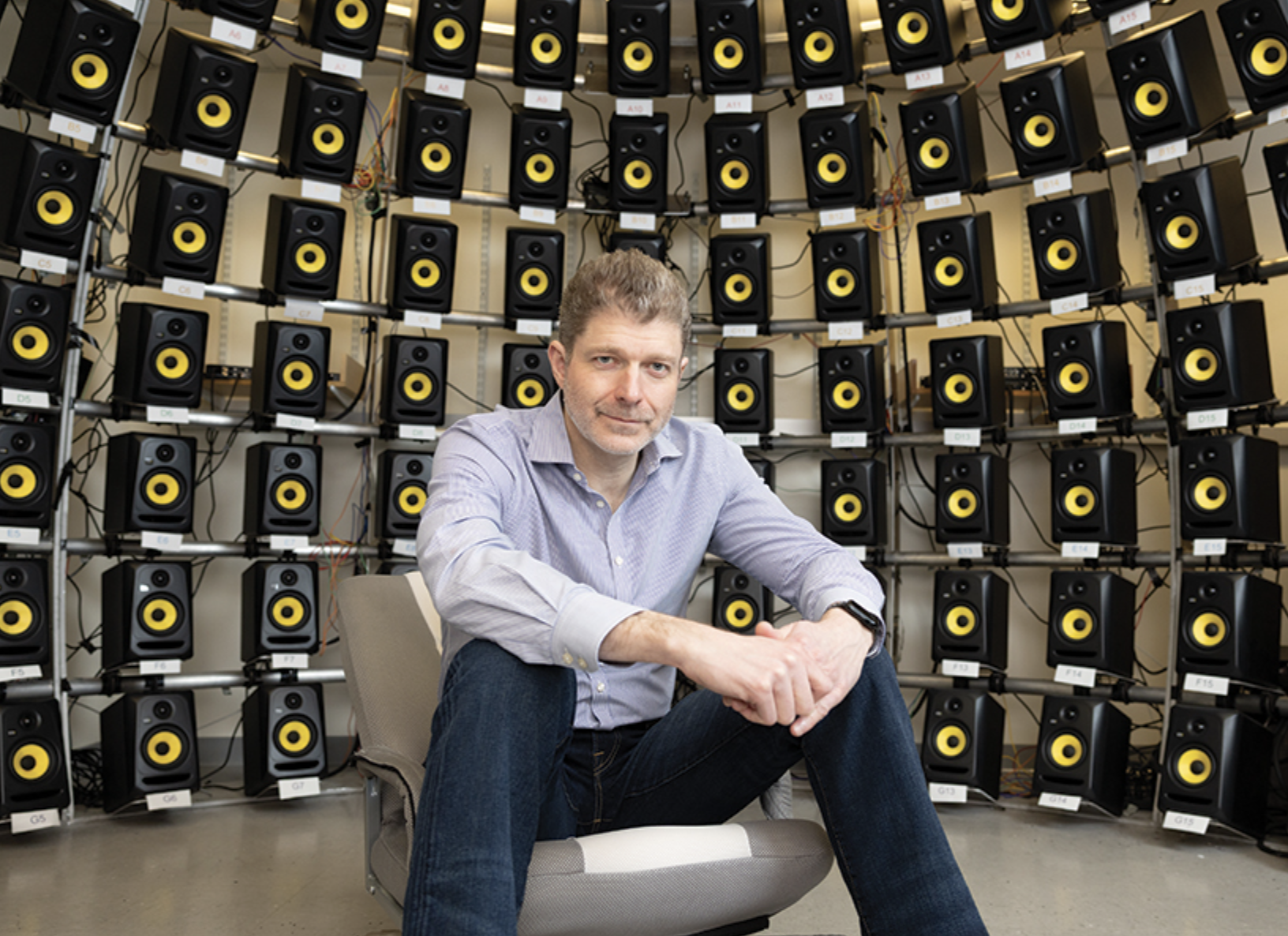
How can a shared AI computing resource benefit an MIT neuroscientist? For Josh McDermott, an MGHPCC AICR early adopter, it has given him a tool to accelerate his quest to explain one of the most fundamental acts of human intelligence: how we listen.
Reporting by Helen Hill for MGHPCC
Josh McDermott, a professor in MIT's Department of Brain and Cognitive Sciences and an investigator at the McGovern Institute for Brain Research, is interested in a deceptively simple question: how do we hear? More specifically, how does the brain separate a voice from background noise, recognize sounds we've heard before, and make sense of the rich acoustic world around us? His research combines neuroscience, psychology, engineering, and artificial intelligence to understand how the brain identifies voices, follows conversations, and navigates noisy environments. The insights gained from this work are helping advance both our understanding of human cognition and the development of technologies ranging from hearing-assistance devices to next-generation AI systems.
Answering those questions requires analyzing large datasets and building sophisticated computational models, making advanced computing resources an increasingly important part of his research toolkit.
The answers have implications that reach far beyond neuroscience. Improved understanding of human hearing can inform everything from hearing aids and assistive devices to speech-recognition systems, AI assistants, communications technologies, and the next generation of intelligent machines.
Increasingly, answering those questions requires AI itself.
“If you’re in the business of studying sensory systems, like I am, [AI has] totally changed the way that we do science.” – Josh McDermott
Access to modern AI tools is helping accelerate McDermott's effort to understand how the brain makes sense of sound. His group uses AI models to generate experimental stimuli, develop computational theories of auditory perception, and test hypotheses about how listeners recognize voices and focus attention in complex acoustic environments. In many cases, the same technologies transforming the broader AI landscape are now serving as powerful instruments for studying human intelligence itself.
A recent example illustrates the power of this approach. In a 2026 paper published in Nature Human Behaviour, McDermott and colleagues developed an artificial neural network to tackle a classic neuroscience challenge known as the "cocktail party problem" - the ability to focus on a single voice amid competing conversations.
The model was not designed to copy human listeners, yet it naturally developed attention strategies that closely mirrored human behavior, successfully predicting both when listeners succeed and when they struggle to focus on a target speaker. Perhaps most importantly, the model generated new scientific predictions that researchers later confirmed experimentally. In other words, AI was not merely analyzing data. It was helping scientists uncover previously unknown features of how the brain works. (Read MIT News coverage of the study.)
This convergence of AI and neuroscience underscores why resources like AICR matter. Training and evaluating sophisticated machine learning models, processing large experimental datasets, and exploring increasingly complex scientific questions demand computing capabilities that are often beyond the reach of individual laboratories. Shared infrastructure gives researchers access to advanced tools without requiring them to build and maintain those capabilities themselves. “AICR was completely essential for some of our recent models of speech perception, and I envision it being critical to our efforts to harness our model to develop better hearing aids”, says McDermott.
For researchers like Josh McDermott, access to AICR is about more than computing power. It provides the ability to ask bigger questions, test more ambitious ideas, and move more quickly from hypothesis to discovery. As AI becomes an increasingly important instrument of scientific research, access to advanced computational infrastructure may prove just as important as access to laboratory equipment, field sites, or scientific instruments.
This story is the first in a series highlighting the researchers putting AICR to work. Their projects span fields ranging from neuroscience and biology to climate science, engineering, and artificial intelligence, but they share a common thread: using shared computational infrastructure to pursue discoveries that would be difficult to achieve alone. As these early adopters demonstrate, the true value of AICR lies not in the hardware itself, but in the new science it makes possible.
Learn more about work in the McDermott Lab
Story Image: Using a computational model of the auditory system, Josh McDermott has shown how the brain can selectively focus attention on one voice among many in a noisy environment — shedding light on a longstanding neuroscientific phenomenon known as the “cocktail party problem.” Photo: Steph Stevens via How is the McGovern Institute using AI?
About the author: Helen Hill, PhD., is a science writer and communications specialist who translates complex, data‑driven research for broad audiences. With a background in computational physical oceanography and numerical ocean modeling, she writes about research and infrastructure at the Massachusetts Green High Performance Computing Center (MGHPCC), highlighting the center’s role in enabling collaboration and discovery.