In this study, MIT/ ORCD and Harvard/FASRC resources at the MGHPCC were used for the pre-work needed to make effective use of exaflop compute resources at a national lab, as well as post-work needed to share and apply the results.
Read this story about modeling the universe at MIT News
Publication:
Oliver Zier, Aaron Smith, Xuejian Shen, Rongrong Liu, Rahul Kannan, Sonja M Koehler, Volker Springel, Rüdiger Pakmor, Mark Vogelsberger, Teodora-Elena Bulichi, Lars Hernquist (2026), Introducing the lumina project: large-volume radiation-hydrodynamic simulations of the epochs of hydrogen and helium reionization, Monthly Notices of the Royal Astronomical Society, doi: 10.1093/mnras/stag1469
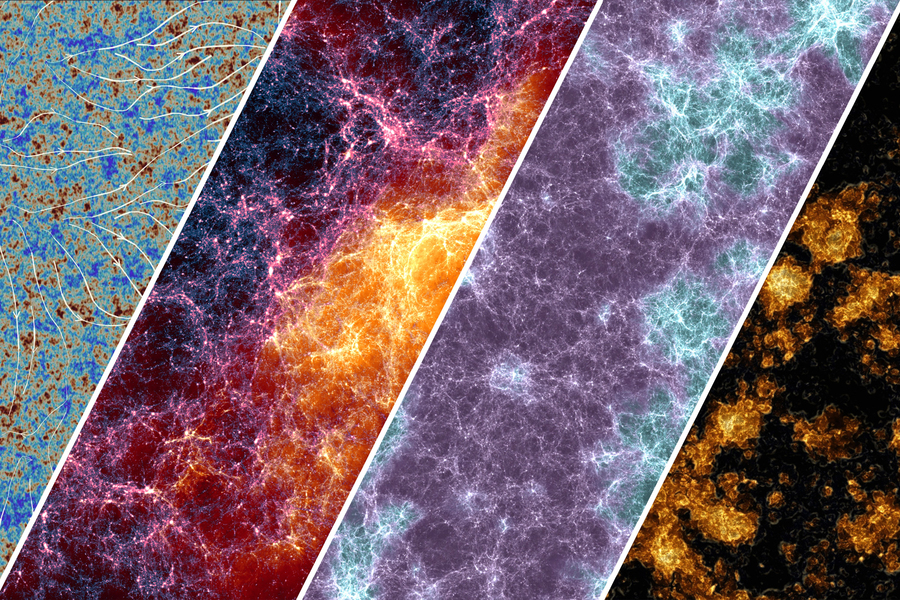
Story Image: A composite image of Lumina’s scales of simulation, depicting (from left to right) the streaming velocities of subatomic particles and dark matter in the beginning of simulation; gas structures during helium reionization, color-coded by how fast the gas is moving; helium reionization where blue indicates regions that are ionized by supermassive black holes; and hydrogen reionization, where bright regions show bubbles where radiation from galaxies has ionized hydrogen, while the dark regions are still neutral. Credit: Lumina collaboration