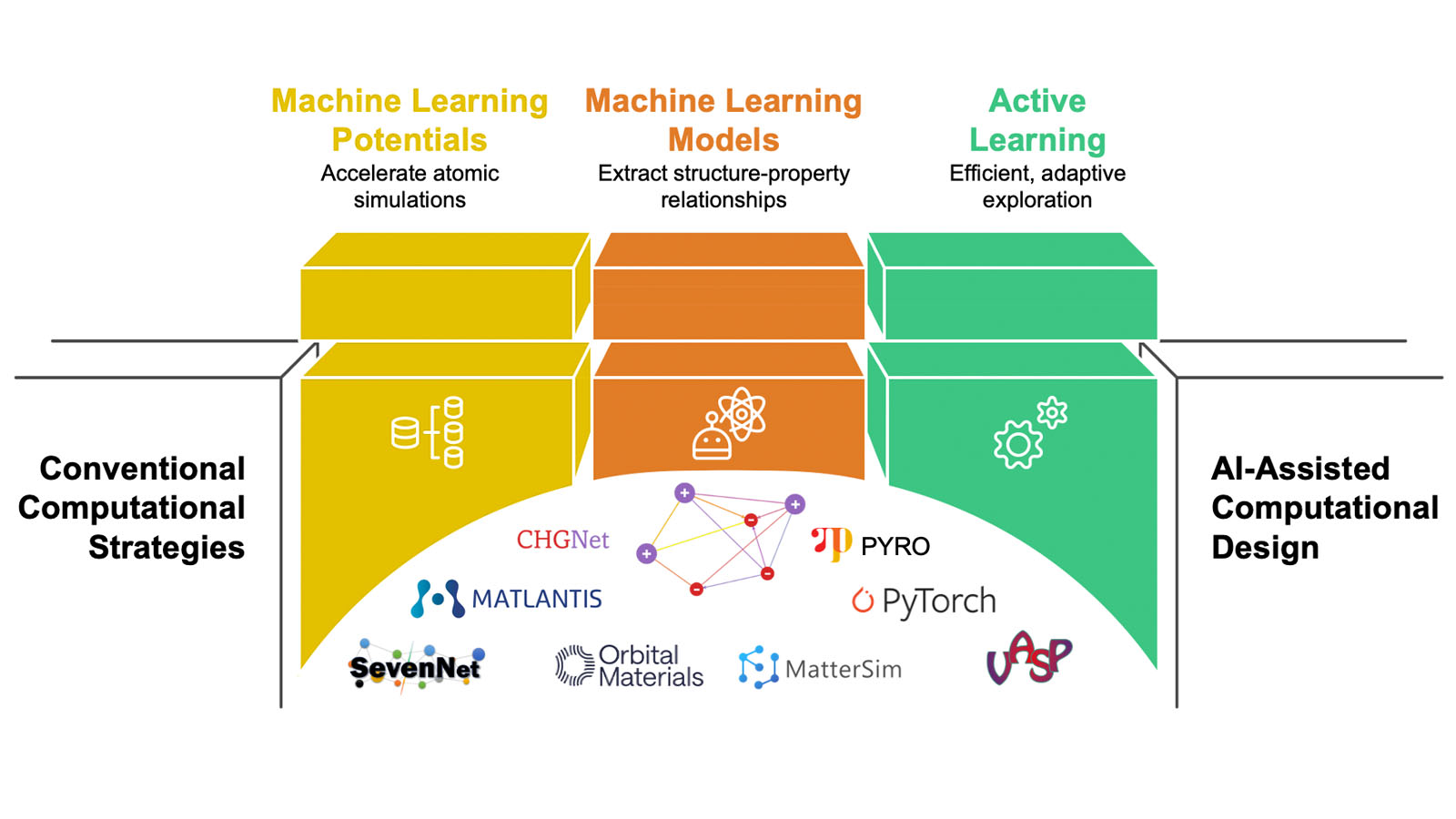
Yu Zhong’s team at Worcester Polytechnic Institute (WPI) uses computing resources housed at the MGHPCC to connect atomic-scale simulations, thermodynamic modeling, and artificial intelligence, helping identify promising materials for energy and manufacturing.
Developing a new material means navigating countless combinations of chemical composition, atomic structure, and processing conditions. Computational methods help researchers narrow those possibilities and focus experiments on the most promising candidates.
At WPI, Professor Yu Zhong leads the Integrated Materials and Processes Design (IMPD) group. His team combines density functional theory (DFT), CALPHAD thermodynamic modeling, machine learning, and experiments to understand material behavior and guide materials development.
Each method contributes a different perspective. DFT uses quantum mechanics to calculate atomic-scale energies and properties. CALPHAD, Calculation of Phase Diagrams, uses thermodynamic descriptions to predict which phases are stable across compositions and temperatures. Machine learning accelerates selected calculations and searches, while experiments test predictions and provide data to improve the models. High-performance computing resources at the MGHPCC support the demanding simulations behind this research.
The group’s work on high-entropy alloys illustrates the value of computational screening. In a recent study, researchers used high-throughput CALPHAD calculations to evaluate 160,000 candidate compositions in the Cr-Co-Ni-Fe system. They identified 214 that met criteria associated with potentially useful deformation mechanisms. These computational candidates provide a focused starting point for experimental investigation. Read the study.
The team also develops methods to understand interfaces, where two materials meet and interact. A framework combining lattice matching, machine-learning potentials, and active learning explores how interface geometry and composition affect stability. Demonstrated using LaCoO₃/La₂NiO₄, the approach helps identify low-energy configurations relevant to energy materials. Read the study.
Alongside these scientific advances, the group developed Masgent, an AI-assisted materials simulation agent. Masgent lets researchers use natural-language instructions to prepare simulation workflows, manipulate atomic structures, and analyze results. It brings DFT workflow tools, machine-learning-potential simulations, and data-analysis utilities into one environment, reducing the manual work required to conduct computational studies. Read the paper or explore the software.
Together, these efforts connect fundamental materials physics with practical tools for discovery. By making calculations more scalable and workflows easier to use, the group helps researchers select stronger candidates for laboratory testing and investigate materials for energy conversion, advanced alloys, and manufacturing.