Menu

Dancing Frog Genomes

The Mangiamele Lab uses MGHPCC computers to study how animal behavior evolves. Their work integrates techniques from physiology, neurobiology, genomics and transcriptomics to understand the evolution of communication signals in frogs and fish.

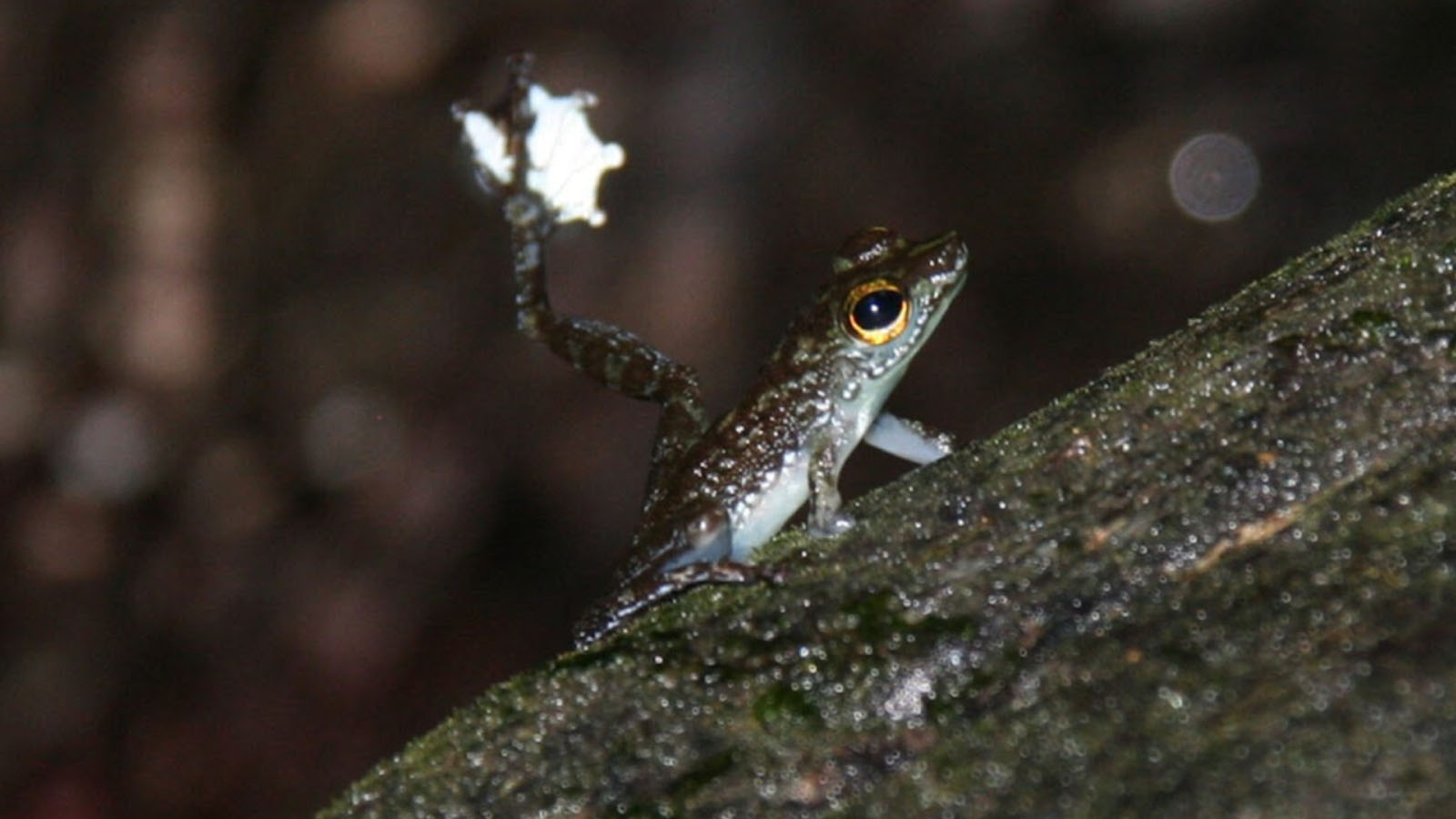
Mangiamele is particularly interested in "foot-flagging," a unique communication behavior in Bornean frogs where males use their brightly colored webbed feet to attract mates and deter rivals. By studying the genomes of foot-flagging frogs and comparing them to non-foot-flagging species, her team investigates how hormones influence behavioral evolution.​ Last year, her team used Boston University's Shared Computer Cluster for their transcriptomic analysis of Bornean frog tadpoles at different developmental stages, examining gene expression to understand neural circuit changes related to foot-flagging. A recent paper on the first foot-flagging frog genome appeared in G3 Genes|Genomes|Genetics.

Lisa Mangiamele
Associate Professor of Biological Sciences, Smith College

Research projects

Surface Behavior
Electron Heating in Kinetic-Alfvén-Wave Turbulence
Software for Unreliable Quantum Computers
Naval and Ocean Renewable Energy Hydrodynamics
Modeling Breast Cancer Spread
New Insights on Binary Black Holes
Staving off the Banana Apocalypse
Sailing the Symbiosis Seascape
All Research Projects

Collaborative projects

ALL Collaborative PROJECTS

OUTREACH & EDUCATION PROJECTS

See ALL Scholarships
100 Bigelow Street, Holyoke, MA 01040