Capturing fast biological activity in three dimensions is a longstanding challenge in microscopy. Traditional high-resolution imaging systems often rely on scanning techniques that collect information sequentially, creating a trade-off between image quality, field of view, and speed. As a result, many important biological events, including neural signaling, blood-flow dynamics, and rapid cellular motion, can occur faster than conventional imaging systems can accurately record.
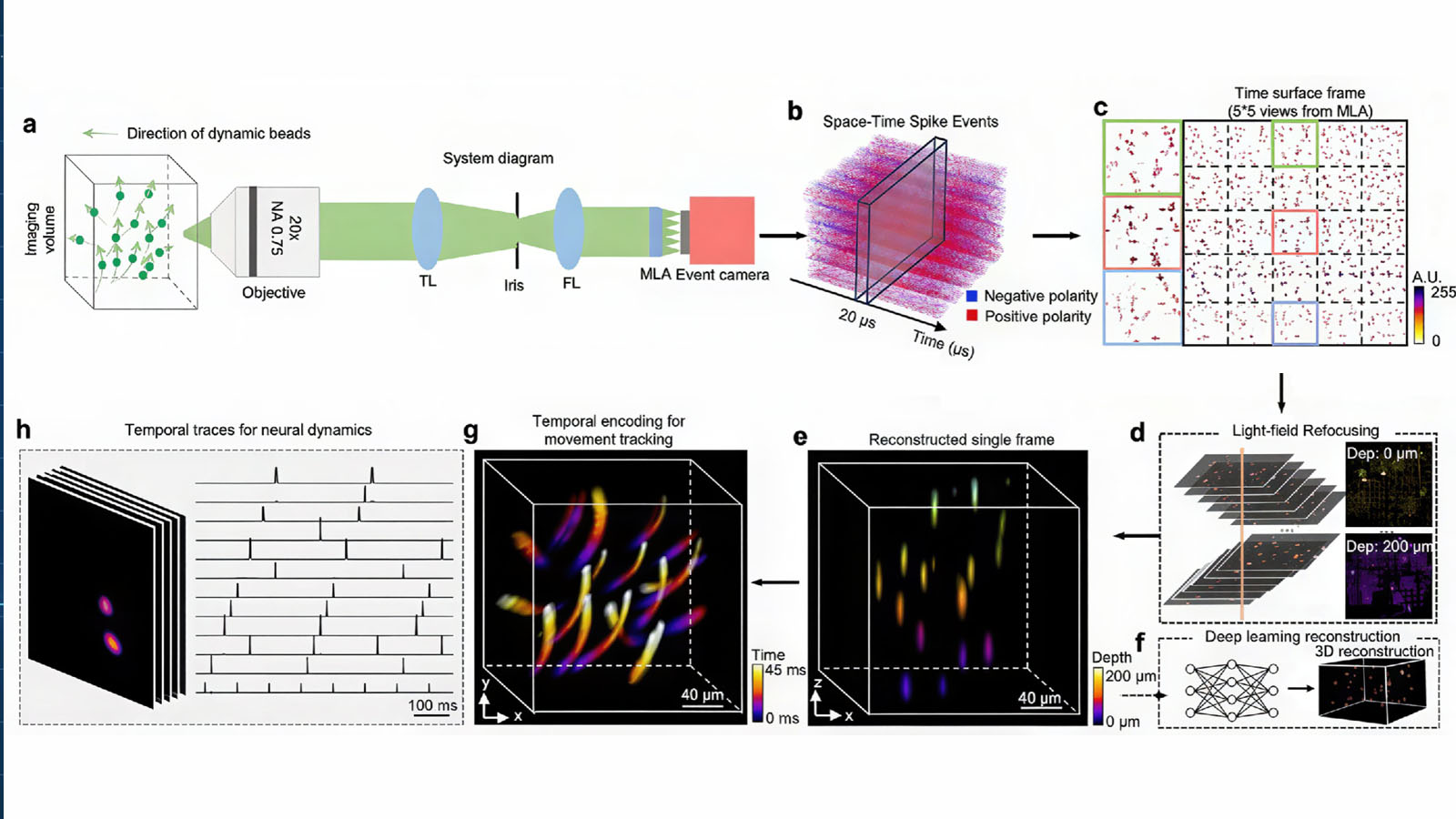
Computational Imaging Systems Lab researchers at BU have developed a new approach called EventLFM (Event Camera Integrated Fourier Light Field Microscopy) to overcome this limitation. The technology combines a specialized event camera with Fourier light field microscopy, enabling researchers to reconstruct three-dimensional biological activity at kilohertz-scale speeds. Unlike conventional cameras that repeatedly capture full images, event cameras record only changes in brightness, dramatically increasing temporal resolution while reducing redundant data collection.
Using EventLFM, the team demonstrated the ability to image rapidly blinking neuronal signals in scattering mouse brain tissue and to track fluorescently labeled neurons in freely moving C. elegans at hundreds to thousands of frames per second. The researchers also incorporated deep-learning-based reconstruction methods that improved image quality and enhanced 3D resolution.
The advance provides scientists with a powerful new tool for observing dynamic biological processes that were previously difficult or impossible to visualize. BU research computing resources were central to the achievement, enabling event-stream processing, computational image reconstruction, deep neural network enhancement, and large-scale analysis of high-speed volumetric imaging data.
Guo R, Yang Q, Chang AS, Hu G, Greene J, Gabel CV, You S, Tian L. (2024), Event camera integrated Fourier light field microscopy for ultrafast 3D imaging, Light: Science & Applications, doi: 10.1038/s41377-024-01502-5
Ruipeng Guo, Xueli Pan, Qilin Deng, Abrar Ahmed, Qianwan Yang, Joseph Greene, Tongyu Li, Suet Ying Chan, Zhixiong Chen, Guorong Hu, Hui Feng, and Lei Tian (2026), Dual-channel event microscopy for ultrafast biological imaging, PNAS, doi: 10.1073/pnas.2531386123