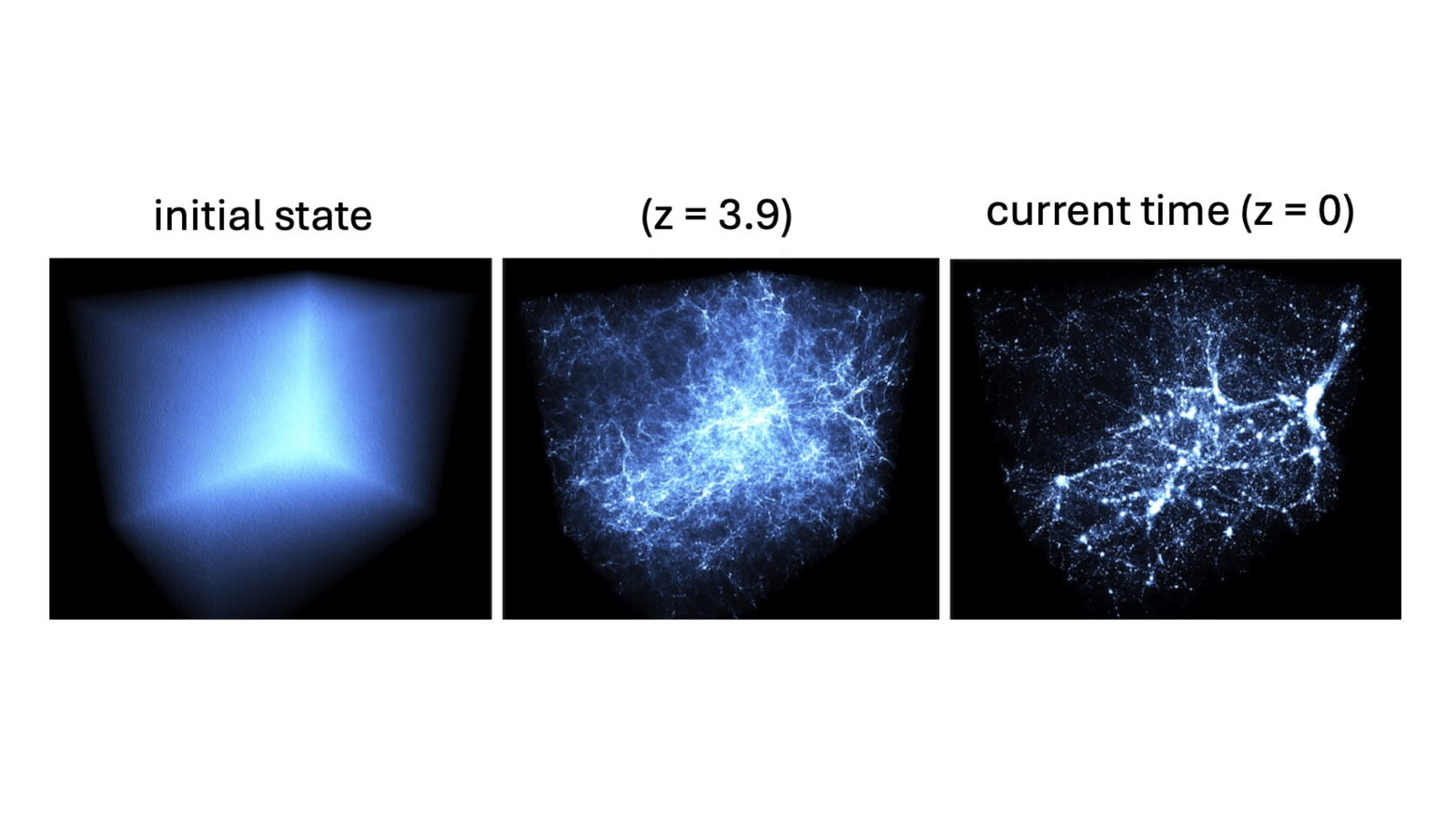
One of the grand challenges in modern cosmology is understanding how matter is distributed throughout the universe. Researchers study this question using massive computer simulations that model the evolution of dark matter and cosmic structure over billions of years. These simulations produce "matter power spectra," mathematical descriptions that capture how matter is clustered across different spatial scales. While highly accurate simulations exist, they are extraordinarily computationally expensive, making it impractical to run new simulations for every possible set of cosmological parameters.
To address this challenge, Walsh and collaborators developed a new Bayesian deep Gaussian process framework that combines information from multiple levels of simulation fidelity, ranging from fast approximate calculations to detailed high-resolution runs. Their approach produces a single best estimate of the matter power spectrum while rigorously quantifying uncertainty. The team also created a second-stage statistical emulator that can rapidly predict matter power spectra for new cosmological models without requiring additional large-scale simulations.
The method performed competitively with the widely used Cosmic Emu benchmark while providing well-calibrated uncertainty estimates. This capability is especially important for next-generation cosmological surveys such as Euclid and the Vera C. Rubin Observatory's Legacy Survey of Space and Time (LSST), which will generate unprecedented volumes of observational data. By combining advanced statistics with high-performance computing resources, the project enables faster and more reliable scientific discovery about the structure and evolution of the universe.
Walsh, S. A., Booth, A. S., Higdon, D., Clark, J., Moran, K. R., & Heitmann, K. (2026), Bayesian Deep Gaussian Processes for Correlated Functional Data: A Case Study in Cosmological Matter Power Spectra, Data Science in Science, doi: 10.1080/26941899.2026.2685315