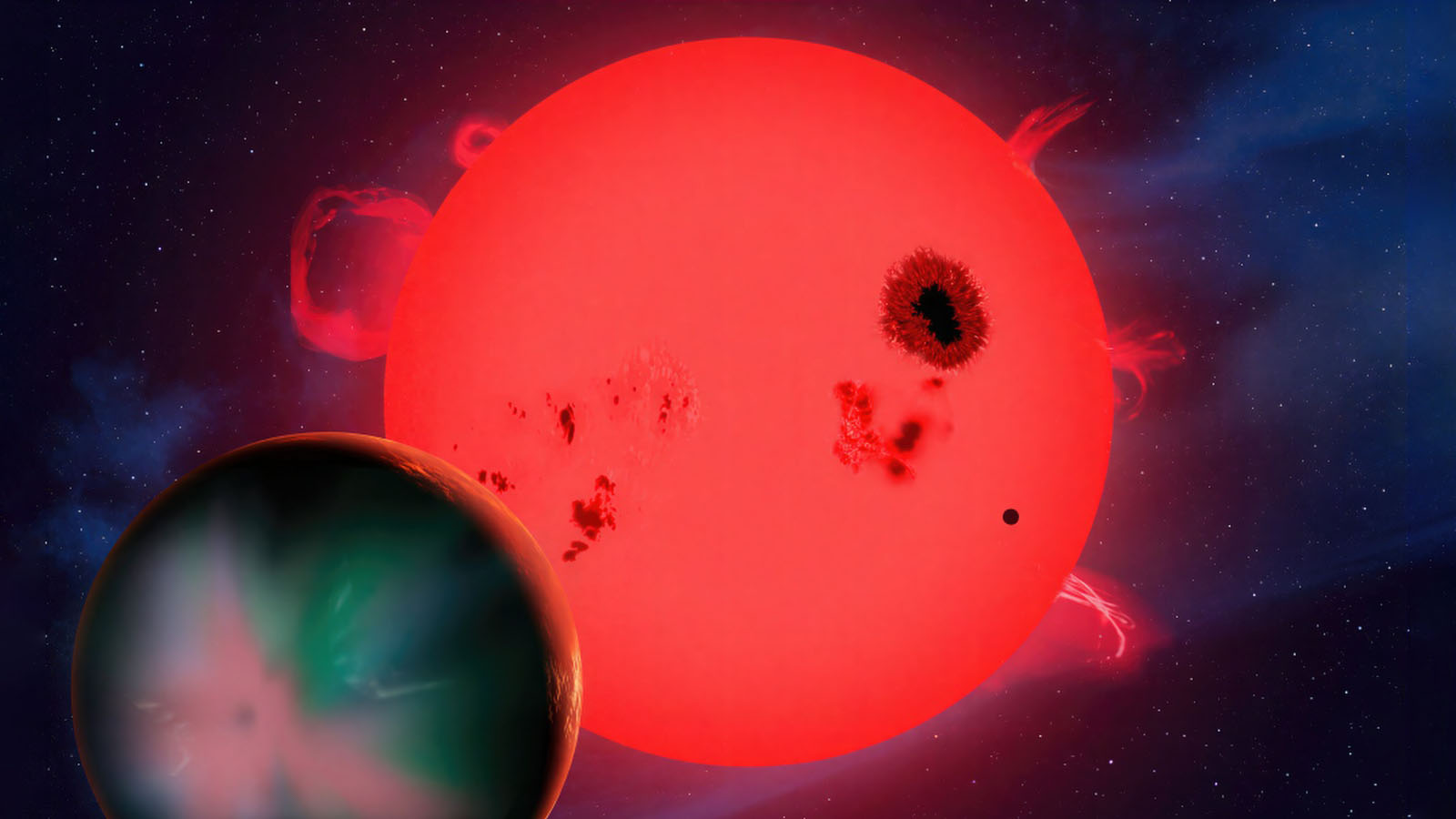
One of the biggest questions in planetary science is what allows a planet to hold onto its atmosphere over billions of years. An atmosphere regulates climate, shields a planet from harmful radiation, and is often considered essential for habitability. Yet planets orbiting small, cool stars known as M dwarfs may face particularly challenging conditions because these stars can bombard nearby planets with energetic radiation and powerful stellar winds.
In a recent study, an international team including UMass Lowell researcher Ofer Cohen asked a simple question: What would happen if present-day Mars orbited Barnard's Star, a nearby M dwarf? Using a suite of sophisticated computer models, the researchers simulated the planet's upper atmosphere, magnetic environment, and multiple atmospheric escape processes. They found that Mars would lose its atmosphere dramatically faster than it does today. Even around an old, relatively quiet M dwarf, atmospheric loss rates were estimated to be hundreds to hundreds of thousands of times greater than those on present-day Mars.
The results suggest that Mars-like planets orbiting many M dwarfs may struggle to retain significant atmospheres for long periods of time. This finding is important because M dwarfs are the most common stars in our galaxy and are prime targets in the search for potentially habitable worlds. The study helps scientists better understand where atmospheres can survive and provides critical context for observations of rocky exoplanets being made by modern observatories such as the James Webb Space Telescope.
A key part of the work was high-performance computing using the MIT SuperCloud housed at the MGHPCC, which enabled researchers to combine multiple physical models into a single end-to-end simulation of a planet's atmospheric evolution.