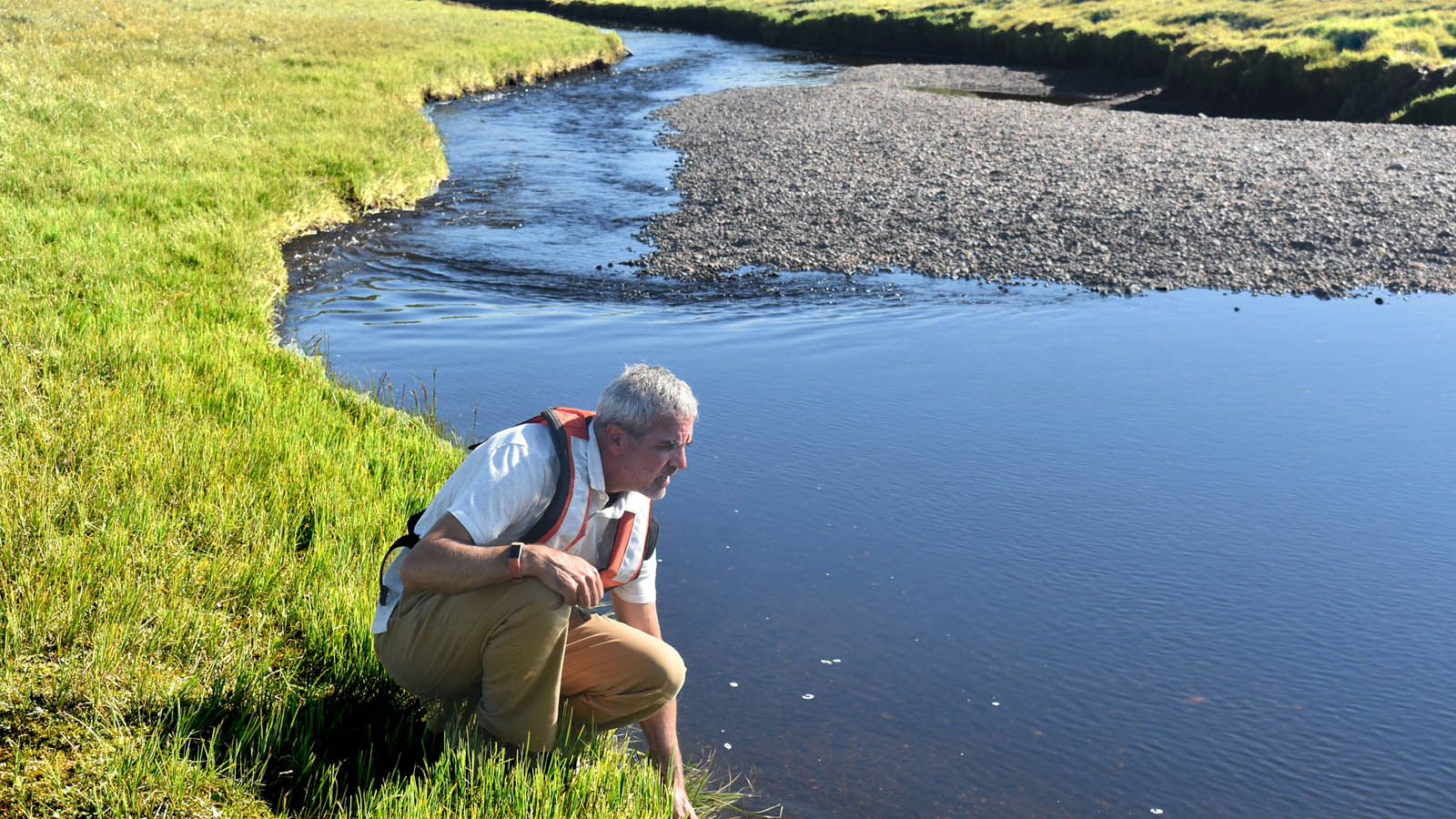
The Arctic is warming faster than most other parts of the planet, but scientists have struggled to understand exactly how thawing permafrost is changing rivers, coastlines, and the global carbon cycle. One of the biggest challenges is the lack of direct observations across northern Alaska, where vast landscapes and limited monitoring make it difficult to measure how water and carbon move from land to sea.
In a first-of-its-kind study, UMass Amherst researcher Michael Rawlins and collaborators used a high-resolution modeling system to examine a Wisconsin-sized region of Alaska’s North Slope over a 44-year period. Their analysis revealed that thawing permafrost is increasing runoff, extending the thaw season into September and October, and mobilizing growing amounts of dissolved organic carbon that had been stored in frozen soils for thousands of years. The largest increases were found in northwest Alaska, where carbon-rich permafrost is particularly vulnerable to warming.
These findings matter because Arctic rivers deliver substantial amounts of freshwater and carbon to coastal ecosystems and the Arctic Ocean. As more ancient carbon is released, some can ultimately contribute to additional carbon dioxide in the atmosphere, reinforcing climate change. The research also provides valuable information for scientists studying coastal ecosystems and environmental change across the Arctic.
A key part of the breakthrough depended on UMass research computing. Rawlins’ Permafrost Water Balance Model simulated daily river flows and carbon exports at one-kilometer resolution, with each model run requiring roughly ten days of continuous processing on supercomputers housed at the MGHPCC.
Rawlins, M. A., et al. (2026), Hydrological Cycle Intensification and Permafrost Thaw Drive Increased Freshwater and Organic Carbon Inputs to Northern Alaska Estuaries, Global Biogeochemical Cycles, doi: 10.1029/2025GB008822