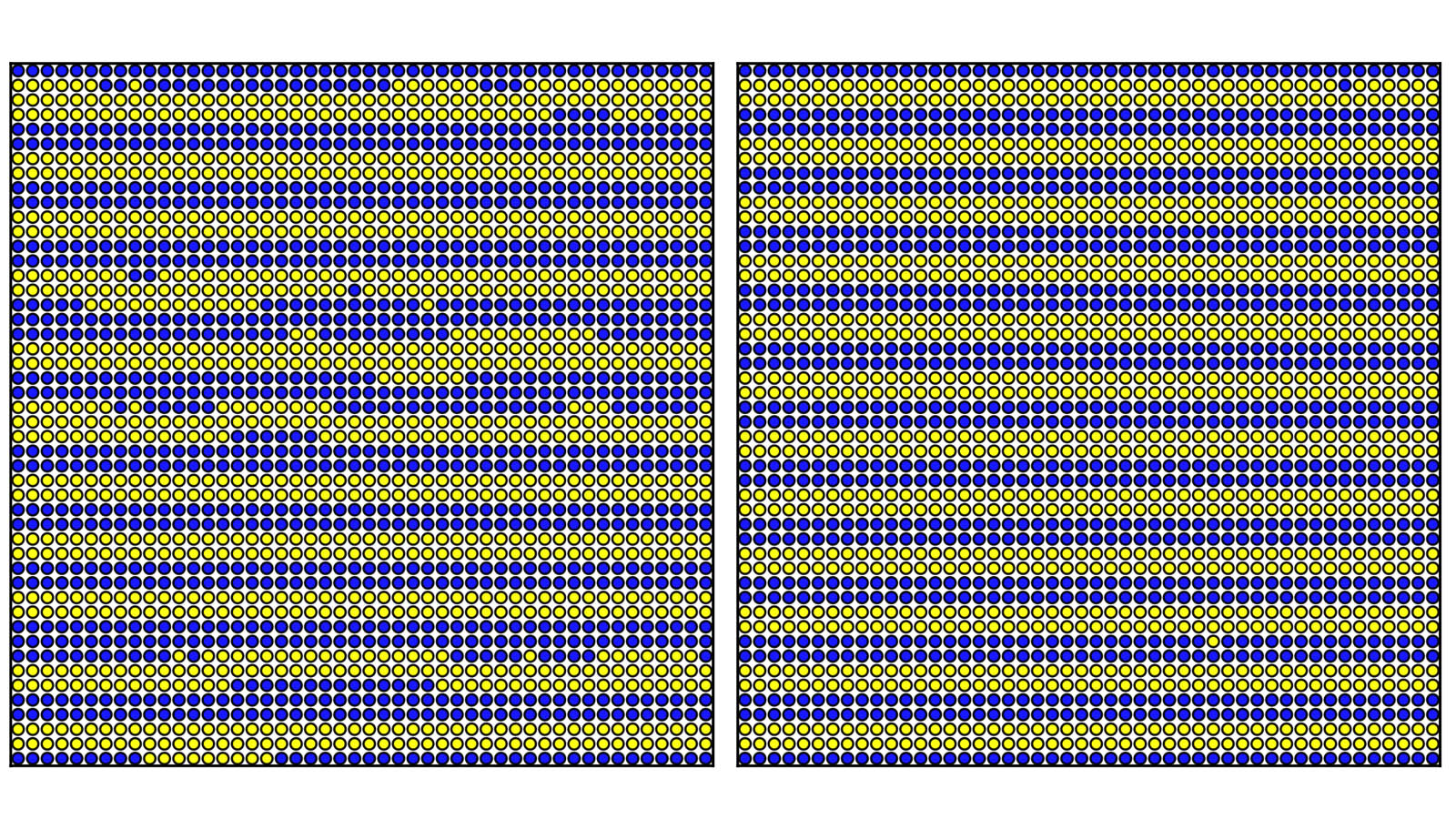
Scientists often use simplified computer models to understand how materials organize themselves at the atomic level. One such model, called the ANNNI model, has puzzled researchers for decades because it appears to pass through a strange intermediate state between being fully ordered and completely disordered. The challenge is that this state is extremely difficult to detect using conventional computer simulations, leaving scientists divided about whether it truly exists.
In this study, UMass Amherst researchers Shane Keiser and Jonathan Machta developed a powerful new computational method that allows computers to explore this complex system far more effectively than previous approaches. Rather than becoming trapped in a limited set of configurations, the new algorithm can efficiently navigate many possible arrangements, helping simulations reach more reliable results.
Using this technique, the pair carried out highly detailed simulations and uncovered strong evidence for the existence of the long-debated intermediate "floating" phase. Their work revealed subtle patterns and transitions that earlier studies could not clearly resolve, providing some of the clearest numerical support yet for this predicted state of matter.
Why does this matter? While the ANNNI model is an idealized representation of nature, it captures behaviors found in many real physical systems where competing forces create complex structures. The study demonstrates how advances in computing and simulation can help scientists tackle longstanding questions and uncover hidden features of the physical world.
This work is as much a computing breakthrough as a physics one. The researchers designed a new simulation algorithm and used large-scale numerical experiments to test it across thousands of temperatures and many different system configurations. The project required substantial computing power to run, compare, and analyze enormous numbers of simulations.
Keiser, S., & Machta, J. (2026), High Resolution Study of the 2D ANNNI Model Using a Two-replica Cluster Algorithm and Population Annealing, arXiv:2606.00882