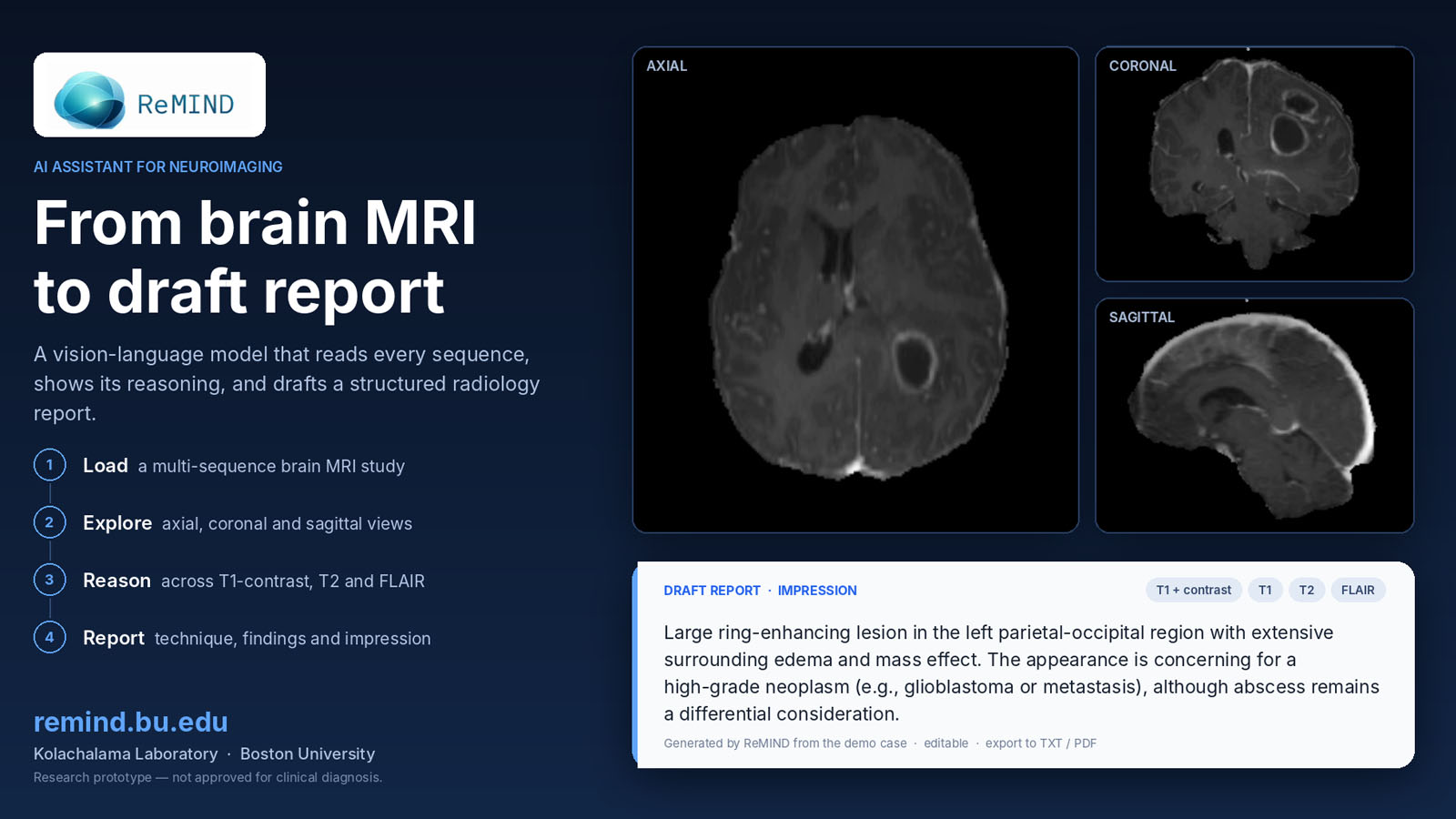
Reading brain MRI scans is a highly specialized task that requires experts to synthesize information from multiple imaging sequences and translate their observations into accurate clinical reports. As the volume of medical imaging continues to grow, researchers are exploring how artificial intelligence can help clinicians review scans more efficiently while maintaining high standards of accuracy and transparency.
To address this challenge, Boston University researcher Vijaya B. Kolachalama and his team developed ReMIND (Radiology–encoded Multimodal Interpretation for Neurological Disorders), a vision-language AI system built for neuroimaging. Rather than analyzing a single image at a time, ReMIND combines information from different types of MRI sequences, much like a radiologist does when examining a patient’s images. The system then generates structured draft reports and allows users to ask follow-up questions about findings and potential diagnoses.
ReMIND was trained and validated using more than 75,000 brain MRI visits, 850,000 imaging sequences, and over one million clinical question-and-answer pairs drawn from diverse clinical and research cohorts. By combining advanced AI with medical expertise, the project aims to make neuroimaging analysis more scalable, consistent, and accessible for research and clinical workflows.
BU’s research computing infrastructure enabled the large-scale model development, data processing, and validation work required to build and test a sophisticated AI system capable of reasoning across complex imaging datasets.