Quantum computers have the potential to solve scientific and engineering problems that would overwhelm even today's fastest supercomputers. But realizing that promise will require interacting with large numbers of quantum bits, or qubits, with high precision. To tackle this challenge, researchers are developing trapped-ion quantum computers based on photonic chips, which offer a scalable and stable alternative to their traditional bulk-optics-based counterparts.
In trapped-ion quantum computers, qubits are formed from electrically charged atoms suspended by electromagnetic fields. Even tiny ion vibrations can introduce imprecision and errors, making it necessary to carefully stabilize the ions through a process called cooling. Until recently, however, photonic-chip-based trapped-ion systems have relied on relatively slow and inefficient cooling techniques.
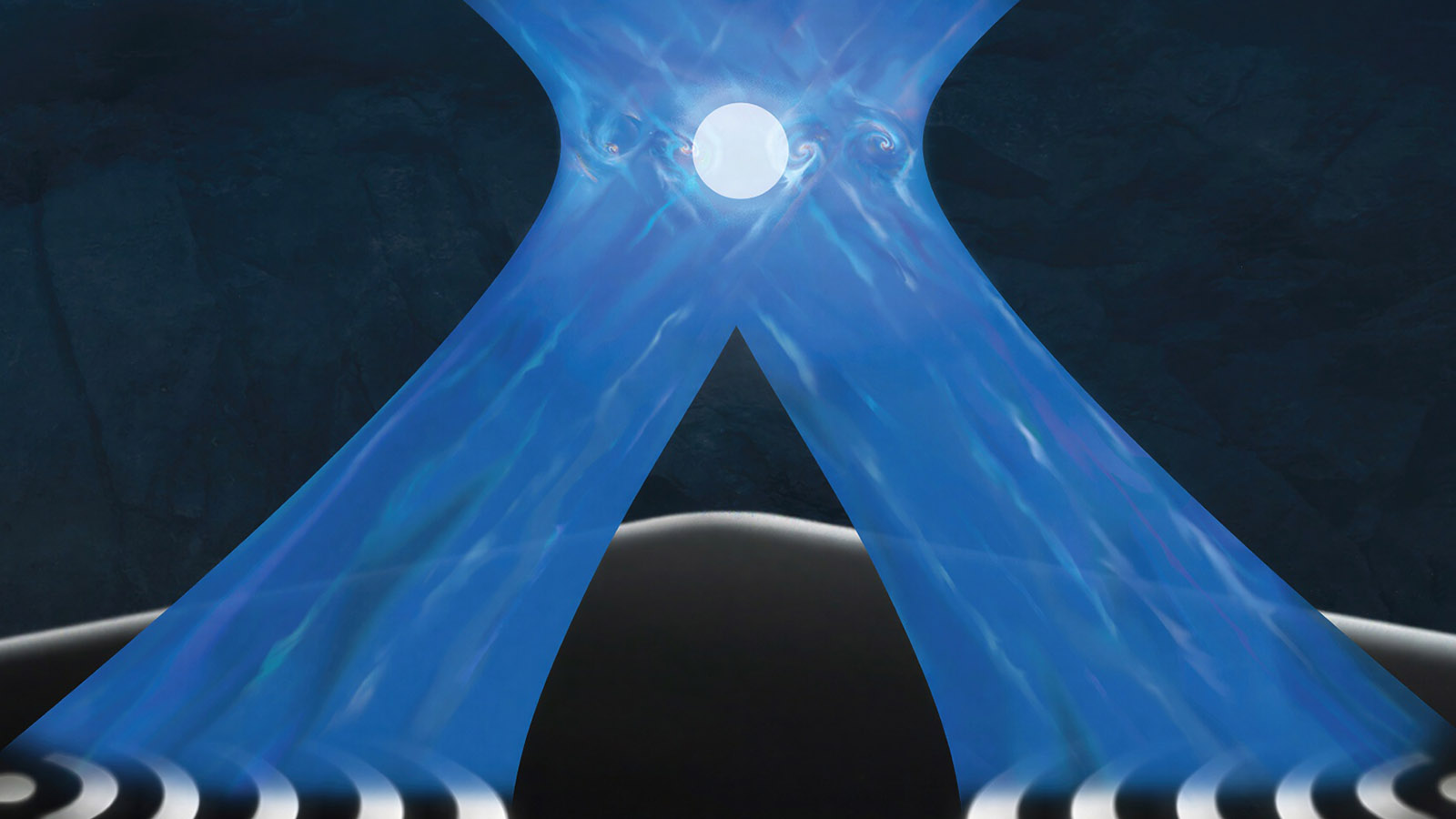
To address this challenge, researchers in the MIT Notaros Group, along with collaborators in the MIT Quanta Group and MIT Lincoln Laboratory, have implemented a faster and more efficient cooling method using a photonic chip. In contrast with the large, complex optical systems typically used to implement this cooling method, the chip contains microscopic antennas that emit tightly focused laser beams, which intersect to form a rotating vortex of light where ions can be cooled. This approach enabled trapped ions to be cooled to temperatures roughly ten times below the limit achievable with standard laser-cooling techniques.
The breakthrough represents an important step toward scalable trapped-ion quantum computers. Chip-based architectures could dramatically reduce the size and complexity of quantum systems while improving performance and manufacturability. More efficient cooling helps stabilize qubits, reducing errors and facilitating quantum operations.
MIT's advanced computing environment played a crucial role in the design and optimization of the photonic devices. Computational modeling guided the engineering of polarization-diverse optical components and helped researchers predict how light would interact with trapped ions, accelerating the development and validation of the new architecture.