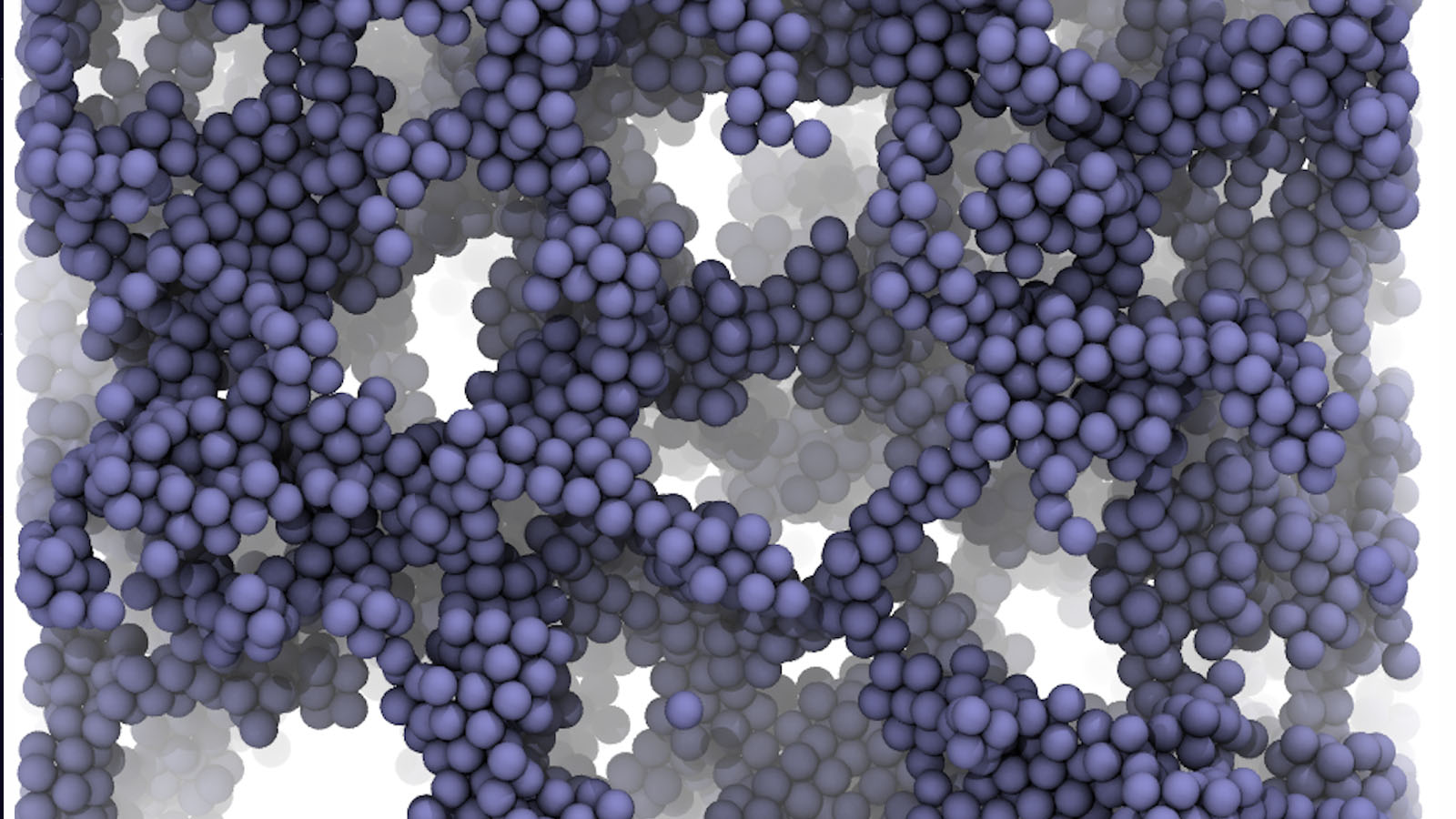
Many common materials, including foods, paints, personal-care products, and biomedical formulations, are made from colloidal gels: networks of microscopic particles suspended in a fluid. A fundamental challenge in materials science is understanding whether a material's past history matters once it has been mixed, deformed, or processed. If two materials ultimately arrive at similar structures, should they also behave the same way mechanically?
Researchers in Northeastern University's Rheoinformatic Lab explored this question using large-scale simulations of binary colloidal gels formed through sequential gelation, where different particle populations assemble at different times. The simulations showed that shear forces tend to drive initially distinct gel structures toward surprisingly similar configurations. Yet the researchers discovered that the materials retained a hidden memory of their formation history. Even after structural differences largely disappeared, the gels continued to exhibit different yielding behaviors and stress responses depending on how they had originally formed.
The study revealed an important distinction between morphological memory and mechanical memory. While deformation can erase many visible signatures of a material's past, it may leave intact microscopic load-bearing networks that continue to influence performance. In some systems, the team observed complex two-step yielding behavior that emerged only when strong interactions and specific formation histories were present.
These findings demonstrate that processing history can serve as a powerful design parameter for engineering soft materials with tailored flow and mechanical properties. By combining high-performance computing, particle-scale simulations, and network-science analysis, the Rheoinformatic Lab uncovered material behaviors that would be extraordinarily difficult to observe directly in laboratory experiments.
Kaltashov, A., & Jamali, S. (2026), Shear-Induced Structural Convergence but Formation-History-Dependent Yielding in Sequentially Gelled Binary Colloidal Networks, arXiv 2606.07672