The findings from MIT mathematicians could help planners design safer, more efficient pedestrian thoroughfares.
The MIT SuperCloud and Lincoln Laboratory Supercomputing Center provided HPC resources for the researchers’ results.
Read this story at MIT News
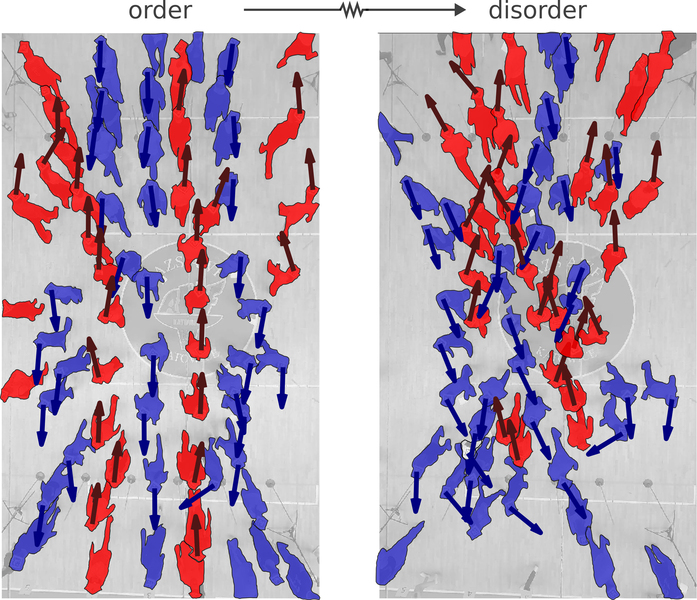
Story image: The researchers carried out controlled crowd experiments and studied how real participants walked through a crowd to reach certain locations. They identified a key measure, “angular spread,” that determines whether pedestrian traffic is ordered or disordered. (Courtesy of the researchers.)
Related Publication:
Bacik, Karol A. et al (2025), Order–disorder transition in multidirectional crowds, PNAS, doi: 10.1073/pnas.2420697122