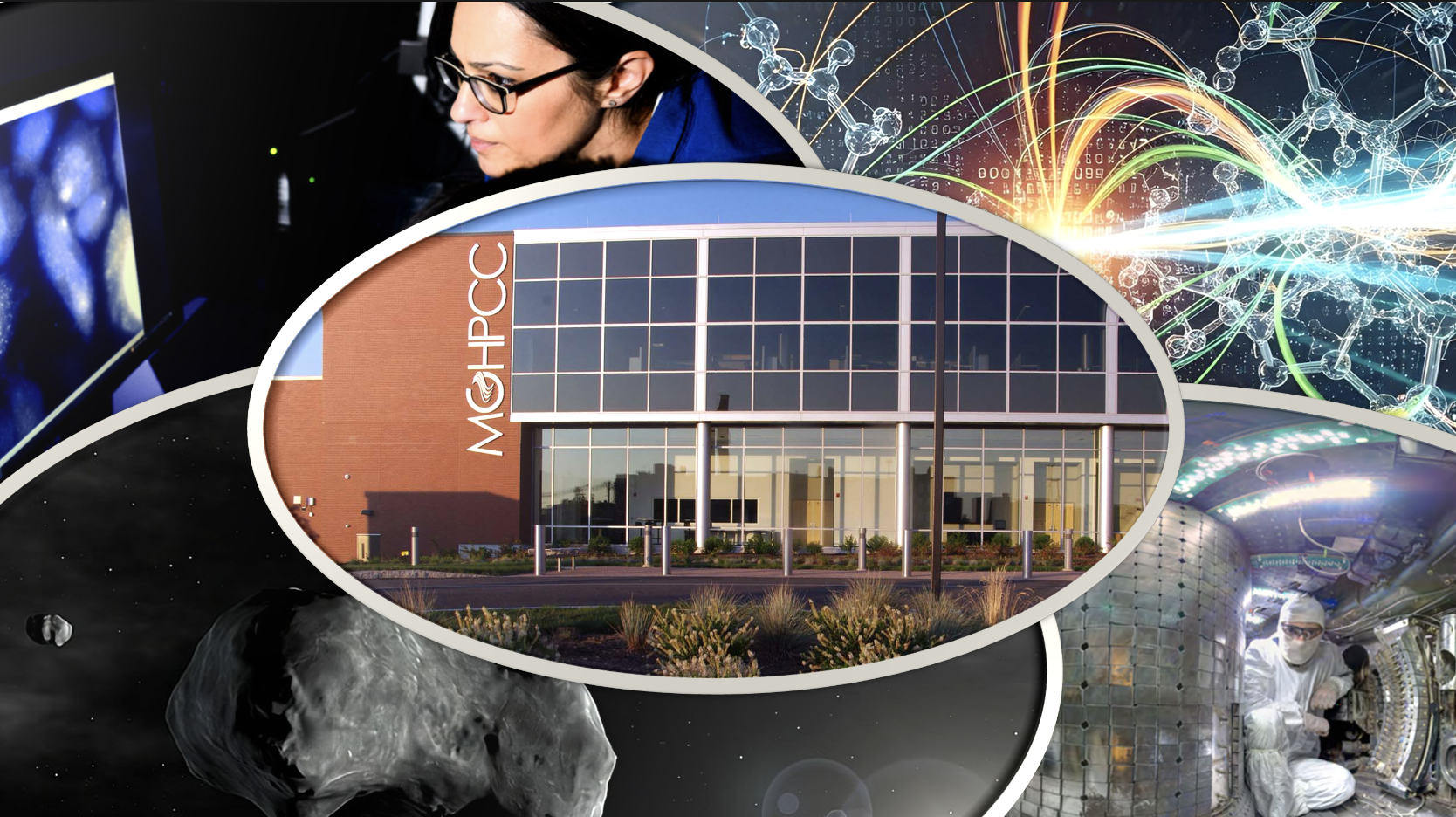
A regional center for research and education where advanced computing helps improve health, energy, resilience, and scientific discovery.
Reporting by Helen Hill for MGHPCC
The Massachusetts Green High Performance Computing Center (MGHPCC) provides state-of-the-art infrastructure for computationally intensive research and education. Located in Holyoke, Massachusetts, the center has been serving as a regional center for research and education, supporting researchers, educators, and students from leading universities across New England for over a decade.
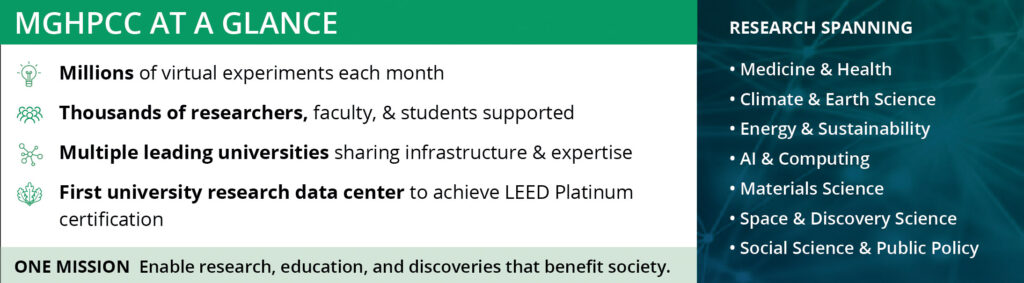
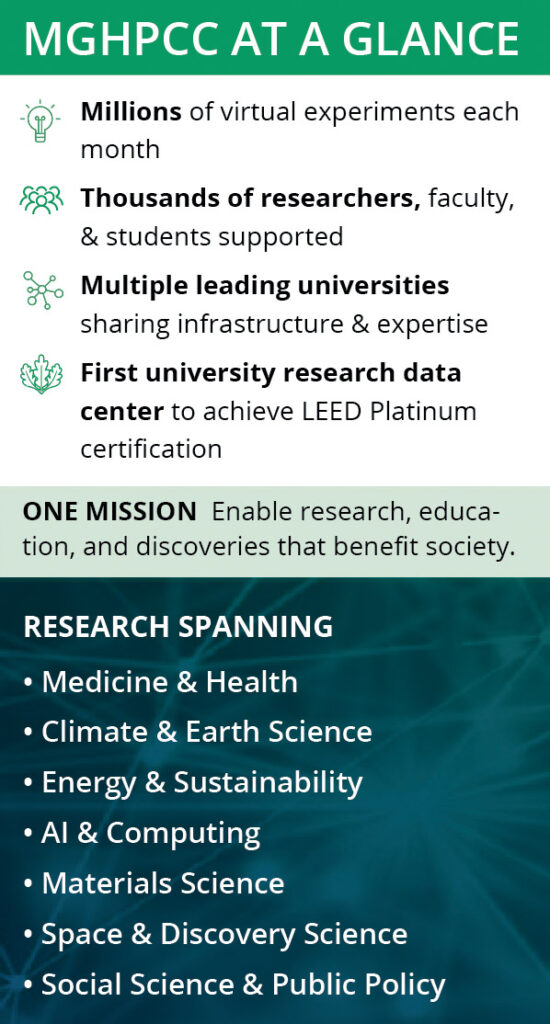
Unlike commercial data centers whose primary mission is to deliver consumer and business services, the MGHPCC exists to support research, education, and scientific discovery. Its resources help researchers answer questions about disease, clean energy, public safety, our natural environment, and the fundamental nature of our universe. Through a unique collaboration among leading universities, the Commonwealth of Massachusetts, and the Holyoke Community, the center provides capabilities that would be far more costly and less efficient for individual institutions to build and operate on their own.
“Unlike commercial data centers built primarily to deliver online services, the MGHPCC exists to support research, education, and scientific discovery. Every month, its resources enable millions of virtual experiments aimed at improving health, strengthening communities, advancing clean energy, protecting the environment, and expanding human knowledge.”
Every month, computers housed at the MGHPCC enable millions of virtual experiments that advance understanding in climate, energy, medicine, materials science, health, space, and computing. Historically, such activities have enriched the economy by yielding new companies, and sometimes entirely new industries. The examples highlighted below represent only a tiny sample of the thousands of projects and investigations that rely on MGHPCC resources each year.
While the specific research projects vary widely, they share a common characteristic: they seek to advance knowledge in ways that improve human health, strengthen communities, expand economic opportunity, protect the environment, and deepen our understanding of the world.
Many MGHPCC-supported projects focus on understanding disease and improving human health. Researchers are searching for new treatments for Alzheimer's disease, using artificial intelligence to improve cancer diagnosis from pathology images, and creating detailed cellular atlases of the human brain that could reveal new insights into neurological disease and cognition.1,2,3
The center also supports public health research, including studies of how infectious diseases evolve and spread, the health benefits of cleaner air, and the risks that extreme heat poses to vulnerable populations.4,5,6 Together, these projects help improve disease prevention, diagnosis, treatment, and health policy.
MGHPCC researchers are helping address some of the world's most pressing energy challenges. Scientists use advanced simulations to better understand fusion plasmas that could power future carbon-free energy systems.7 Others employ artificial intelligence and materials modeling to design catalysts and new materials for sustainable energy production, storage, and conversion.8
Researchers are also developing techniques to improve the energy efficiency of large-scale computing infrastructure, reducing its cost and impact, helping make future computing more sustainable.9
Some of the most fundamental scientific questions require extraordinary computing resources. For example, MGHPCC systems help researchers analyze data from the IceCube Neutrino Observatory in Antarctica to better understand the origins of high-energy particles arriving from deep space.10 Astronomers are also studying the evolution of galaxies and probing the physics of black holes and dark matter.11,12
Closer to home, Earth scientists use MGHPCC resources to study our planet’s climate, Arctic river systems, marine ecosystems, volcanic and earthquake activity, and the atmospheric effects of major eruptions, improving our understanding of Earth's past, present, and future.13,14
Advanced computing plays an increasingly important role in disaster preparedness and public safety. MGHPCC researchers are improving the detection of potentially hazardous asteroids, developing artificial-intelligence systems for tornado forecasting, and helping communities better understand and prepare for flood risks.15,16,17
Other projects examine threats to agriculture and food security, including diseases that endanger major crops.18 These efforts help strengthen resilience in the face of natural, environmental, and societal hazards.
Researchers use MGHPCC resources to design next-generation materials for energy systems, electronics, manufacturing, and healthcare. Projects include biodegradable alternatives to microplastics, advanced 3D-printed materials, and simulations that reveal how materials behave at the atomic scale.19,20,21
These computational approaches dramatically accelerate discovery and reduce the time required to move promising technologies from the laboratory into practical use.
The MGHPCC is not only a place where researchers use advanced computing—it is also where they develop it. Scientists are creating AI tools that accelerate scientific discovery, improve healthcare, and make complex scientific information more accessible.22,23
Researchers are also advancing cloud computing, robotics, energy-efficient data centers, and quantum computing technologies that may someday solve problems beyond the reach of conventional computers.24,25,26
MGHPCC resources support efforts to understand both natural and artificial intelligence. Researchers at the Kempner Institute and other organizations are investigating how brains and machines learn, reason, and process information, while neuroscientists are building increasingly detailed maps of the human brain.27,28
The center also powers large-scale social science research. Economists and policy researchers use enormous datasets to study economic mobility, voting behavior, public policy, and opportunity, helping inform decisions that affect millions of people.28, 30
The MGHPCC was designed with environmental stewardship as a core principle. Among foundational early decisions was the choice to locate on a former industrial site, and then undertake brownfield remediation of 100 years of industrial impact, rather than break ground on a greenfield site. Detailed attention to maximizing energy efficiency while minimizing environmental impacts allowed it to become the first university research data center ever to achieve LEED Platinum Certification, the highest level of recognition for green building design. Innovative cooling, airflow, and power-management systems reduce the environmental footprint of the facility while supporting world-class research and providing meeting spaces for the local community.31
A Shared Resource for Research and Education
The projects highlighted here are only a tiny fraction of the work taking place at the MGHPCC. Every month, resources housed at the center enable millions of virtual experiments and analyses across a vast range of disciplines. While the specific projects vary widely, they share a common purpose: advancing knowledge in ways that benefit society: to improve health, protect communities from hazards both local and existential, expand economic opportunity, and deepen our understanding of the world around us.
Story image: Research at the MGHPCC: seeking to improve human health, protect communities from hazards both local and existential, expand economic opportunity, and deepen our understanding of the world around us- credit: MGHPCC
About the author: Helen Hill, PhD., is a science writer and communications specialist who translates complex, data‑driven research for broad audiences. With a background in computational physical oceanography and numerical ocean modeling, she writes about research and infrastructure at the Massachusetts Green High Performance Computing Center (MGHPCC), highlighting the center’s role in enabling collaboration and discovery.