Welcome to the MGHPCC Virtual Booth

Yale University

Bone Ratios and Big Data

Using a combination of classic paleontology methods, machine-learning algorithms, and 3D modeling techniques Caleb Gordon studies the evolution of aquatic and macrocarnivorous lifestyles in ancient reptiles.

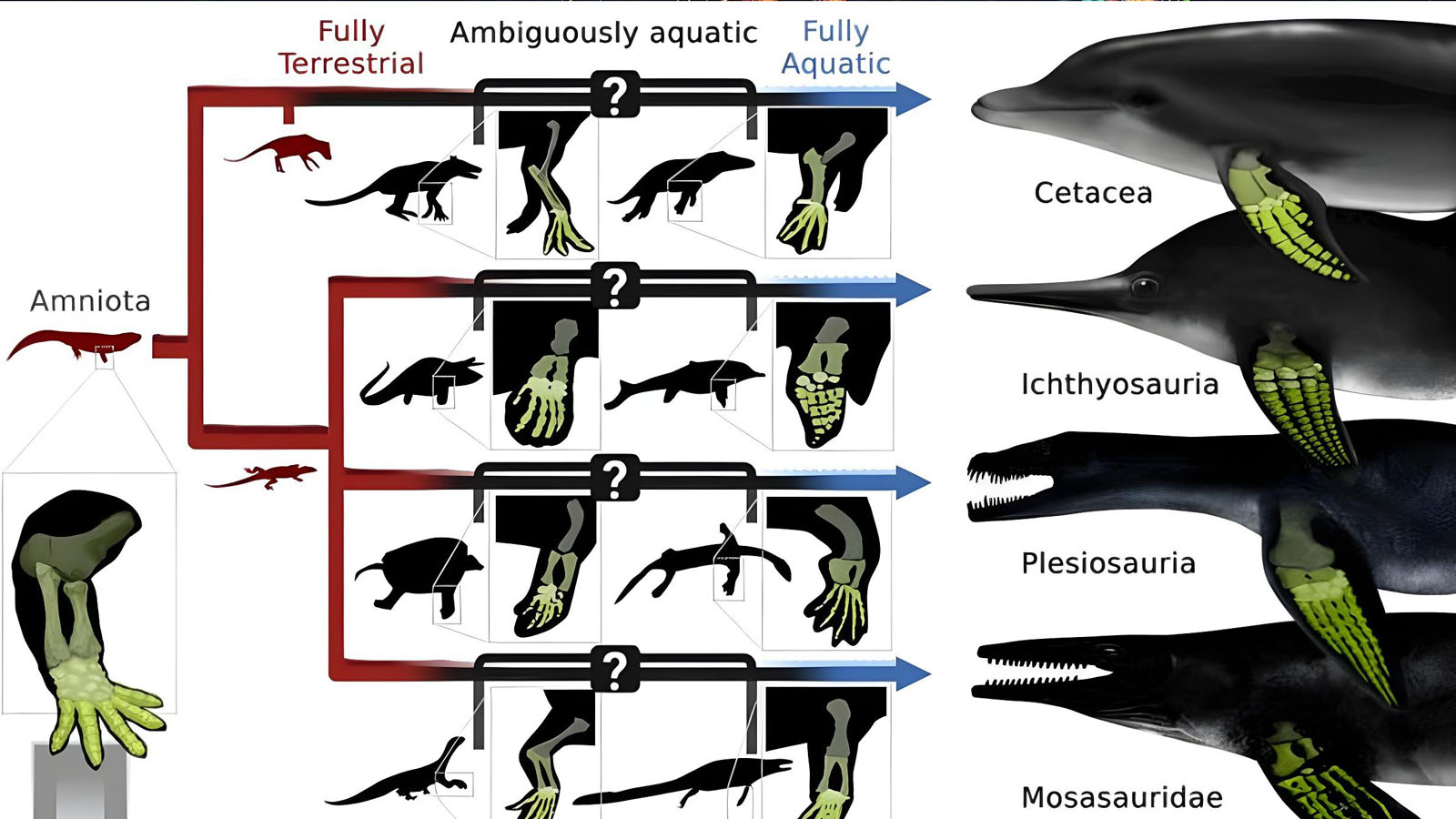
Aquatic mammals and reptiles are striking examples of convergent evolution, but understanding how aquatic habits evolved in these groups presents paleontologists with a massive computational challenge. Caleb Gordon and his colleagues sought to address this challenge using a combination of classic paleontology methods, 3D data visualization, and phylogenetically informed machine-learning algorithms. Yale's high-performance computing resources made his new analytical approach tractable.

A recent paper details a machine-learning framework Gordon and co-authors developed to predict aquatic habits and soft-tissue limb features—like flippers—in extinct amniotes using fossilized limb proportions. By analyzing over 11,000 linear measurements and geometric morphometric data from >750 specimens, the team found that relative hand length is a powerful predictor of flipper presence and aquatic lifestyle, achieving over 90% accuracy across mammals and reptiles.

Their phylogenetic models revealed that while interdigital webbing cannot be reliably inferred from bones alone, flippered limbs and highly aquatic habits correlate strongly with specific forelimb proportions. Applying these models to extinct species clarified long-standing debates about the ecology of marine reptiles, showing multiple independent origins of flippers and aquatic lifestyles in groups like mosasaurs, sauropterygians, and non-avian theropods.

This work required extraordinary computational resources. Gordon ran multi-day job arrays involving 10,000 CPUs in parallel, consuming hundreds of thousands of CPU-hours on Yale’s Grace HPC cluster. These resources enabled complex phylogenetic regressions and simulations across millions of tree configurationsdemonstrating how research computing is transforming paleobiology by revealing hidden evolutionary patterns in Earth’s history.
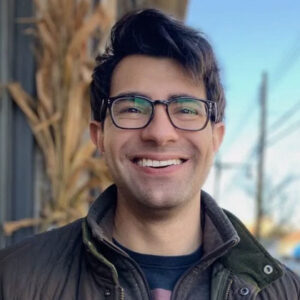
Caleb M. Gordon
Now a Postdoctoral Researcher at the Florida Museum of Natural History, Gordon received his PhD in the Department of Earth and Planetary Sciences at Yale University in 2025

Principal Members

Yale

Featured Projects

SC25 Project
A Safer Way to See Inside Cells
Adaptive Deep Learning Systems Towards Edge Intelligence
SC25 Project
AI for Cancer Diagnosis
SC25 Project
AI Pareidolia
SC25 Project
AI That Speaks Human About Health
Ancient DNA reveals pervasive directional selection across West Eurasia (working title)
Bayesian Deep Gaussian Processes for Correlated Functional Data (working title)
SC25 Project
Better Pathogen Targeting
Research Computing Center
BU Research Computing Services
SC25 Project
Building for Floods
Campus Research Computing Consortium
Cellular Protein Electrochemical Balance (working title)
Combining AI with laboratory evolution yields improved proteins (working title)
Computation + Machine Intelligence | Wu Tsai Institute
Computational Modeling of Biological Systems
Computer Simulations Show Strong Ocean Currents Reduce Size of Surface Waves (working title)
SC25 Project
Computing Hidden Health Threats from Heat
Contribution of Task-Irrelevant Stimuli to Drift of Neural Representations (working title)
Deciphering Alzheimer's Disease
Developing Advanced Materials for a Sustainable Energy Future
Earth & Planetary Sciences at Harvard University
Earth’s Nighttime Lights Are Getting More Volatile—What Does That Mean? (working title)
Enhancing a superconductor's potential (working title)
EventLFM: Event camera integrated fourier light field microscopy for ultrafast 3D imaging (working title)
MGHPCC Project
Expanding Computing Education Pathways (ECEP) Alliance
SC25 Project
FlowER: AI for Predicting Chemical Reactions
SC25 Project
Grid Responsive Data Centers
Research Computing Center
Harvard FASRC
IceCube: Hunting Neutrinos
Identifying non-coding variant effects at scale via machine learning models of cis-regulatory reporter assays (working title)
IEEE High Performance Extreme Computing Conference
Impact of Marine Heatwaves on Coral Diversity
Impulse response functions as a framework for quantifying ocean-based carbon dioxide removal (working title)
Is it time to expand our thinking about dark matter? A new study says yes (working title)
Research Computing Center
Lincoln Laboratory Supercomputing Center (LLSC)
SC25 Project MGHPCC Project
MGHPCC AI Computing Resource (AICR)
MGHPCC Supercloud
SC25 Project
Microplastic-Free by Design
Research Computing Center
MIT Office of Research Computing and Data
SC25 Project
Multifunctional 3D-Printed Materials
MGHPCC Project
National Data Platform
SC25 Project
Naval and Ocean Renewable Energy Hydrodynamics
Research Computing Center
NEU Research Computing
New MetaMaterials Take Inspiration from Deep Sea Sponges (working title)
MGHPCC Project
Northeast Storage Exchange
Novel study at URI seeks to treat neurological symptoms of rare genetic disorder (working title)
Open Cloud Testbed
SC25 Project MGHPCC Project
OSN - Open Storage Network
Planning, Reminders and Micro-Incentives to Walk After Traumatic Brain Injury: A Pilot Randomized Control Trial (working title)
MGHPCC Project
PNRP- protype national research platform
Protein Folding as a Jamming Transition (working title)
Researchers Discovering New Mosquito-Specific Viruses (working title)
Revolutionizing Materials Design with Computational Modeling
Rewind
SC25 Project
Sailing the Symbiosis Seascape
Shear-Induced Structural Convergence but Formation-History-Dependent Yielding in Sequentially Gelled Binary Colloidal Networks (working title)
SC25 Project
Shining a Light on Dark Matter
Simulating Large Biomolecular Assemblies
Single-molecule tracker illuminates workings of cancer-related proteins (working title)
Software for Unreliable Quantum Computers
SC25 Project
Staving off the Banana Apocalypse
SC25 Project
Supporting Data-intensive Social Science
The Kempner Institute - Unlocking Intelligence
The US ATLAS Northeast Tier 2 Center
This AI scientist can run an X-ray experiment. Self-driving labs may come next (working title)
SC25 Project
Tracking Environmental Health Risks
Research Computing Center
UMass - URI Unity Cluster
Research Computing Center
UMass Amherst Research Computing and Data
Unity HPC and AI Platform
Research Computing Center
URI Institute for AI & Computational Research
SC25 Project
Wrangle Range Modeling
Yale Budget Lab
Yale Center for Genome Analysis (YCGA)
Research Computing Center
Yale Center for Research Computing
Yale Department of Earth and Planetary Sciences
Zebrafish Reveal New Insights into Biology of Autism (working title)
100 Bigelow Street, Holyoke, MA 01040