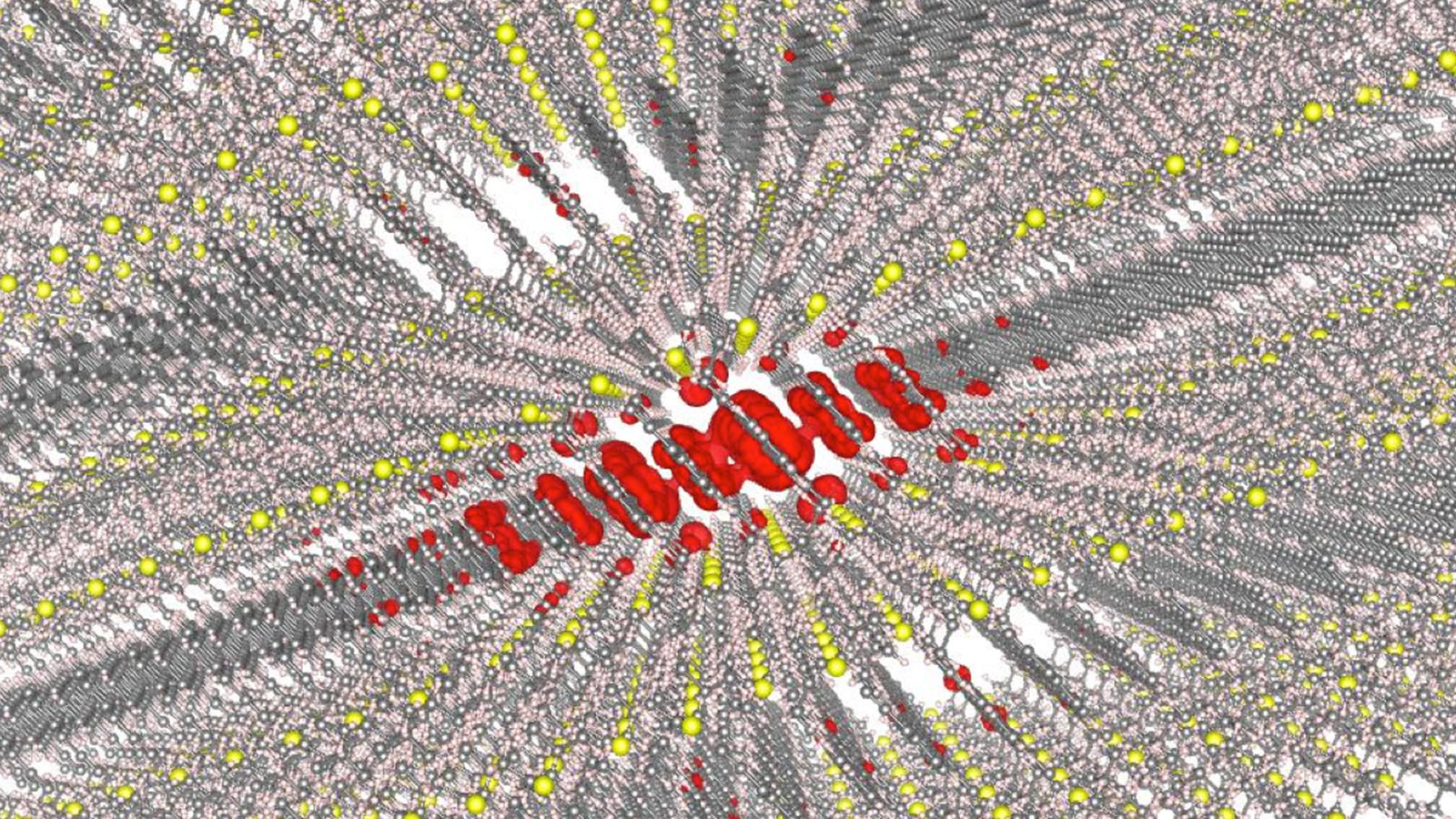
The Sharifzadeh Group at Boston University develops and applies computational methods to understand how a material’s atomic structure, electronic interactions, and thermal environment shape its properties. Using high-performance computing, the group applies first-principles methods such as density functional theory and many-body perturbation theory to reveal how electrons, excitons, defects, spins, and lattice vibrations interact, and help predict how those interactions influence a material’s optical and electronic behavior.
The group studies a diverse range of systems, from organic semiconductors and molecular crystals to two-dimensional materials, carbon nanotubes, and bio-inspired molecular assemblies. The research addresses phenomena such as exciton–phonon coupling, defect-localized optical states, charge and energy transport, and spin-dependent optical properties. By connecting atomic-scale simulations with experimentally measurable behavior, the group aims to identify design principles for materials relevant to energy conversion, optoelectronics, and emerging quantum technologies. The computational challenges arising from the physical and structural complexity of these systems make scalable algorithms and high-performance computing central to this work.