Welcome to the MGHPCC Virtual Booth

Worcester Polytechnic Institute

Accelerating Materials Innovation with DFT, CALPHAD, and AI

Yu Zhong’s MGHPCC-powered simulations, thermodynamic modeling, and AI are accelerating the design of energy and manufacturing materials.

Yu Zhong’s team at Worcester Polytechnic Institute (WPI) uses computing resources housed at the MGHPCC to connect atomic-scale simulations, thermodynamic modeling, and artificial intelligence, helping identify promising materials for energy and manufacturing.

Developing a new material means navigating countless combinations of chemical composition, atomic structure, and processing conditions. Computational methods help researchers narrow those possibilities and focus experiments on the most promising candidates.

At WPI, Professor Yu Zhong leads the Integrated Materials and Processes Design (IMPD) group. His team combines density functional theory (DFT), CALPHAD thermodynamic modeling, machine learning, and experiments to understand material behavior and guide materials development.

Each method contributes a different perspective. DFT uses quantum mechanics to calculate atomic-scale energies and properties. CALPHAD, Calculation of Phase Diagrams, uses thermodynamic descriptions to predict which phases are stable across compositions and temperatures. Machine learning accelerates selected calculations and searches, while experiments test predictions and provide data to improve the models. High-performance computing resources at the MGHPCC support the demanding simulations behind this research.

Turning calculations into materials candidates

The group’s work on high-entropy alloys illustrates the value of computational screening. In a recent study, researchers used high-throughput CALPHAD calculations to evaluate 160,000 candidate compositions in the Cr-Co-Ni-Fe system. They identified 214 that met criteria associated with potentially useful deformation mechanisms. These computational candidates provide a focused starting point for experimental investigation. Read the study.

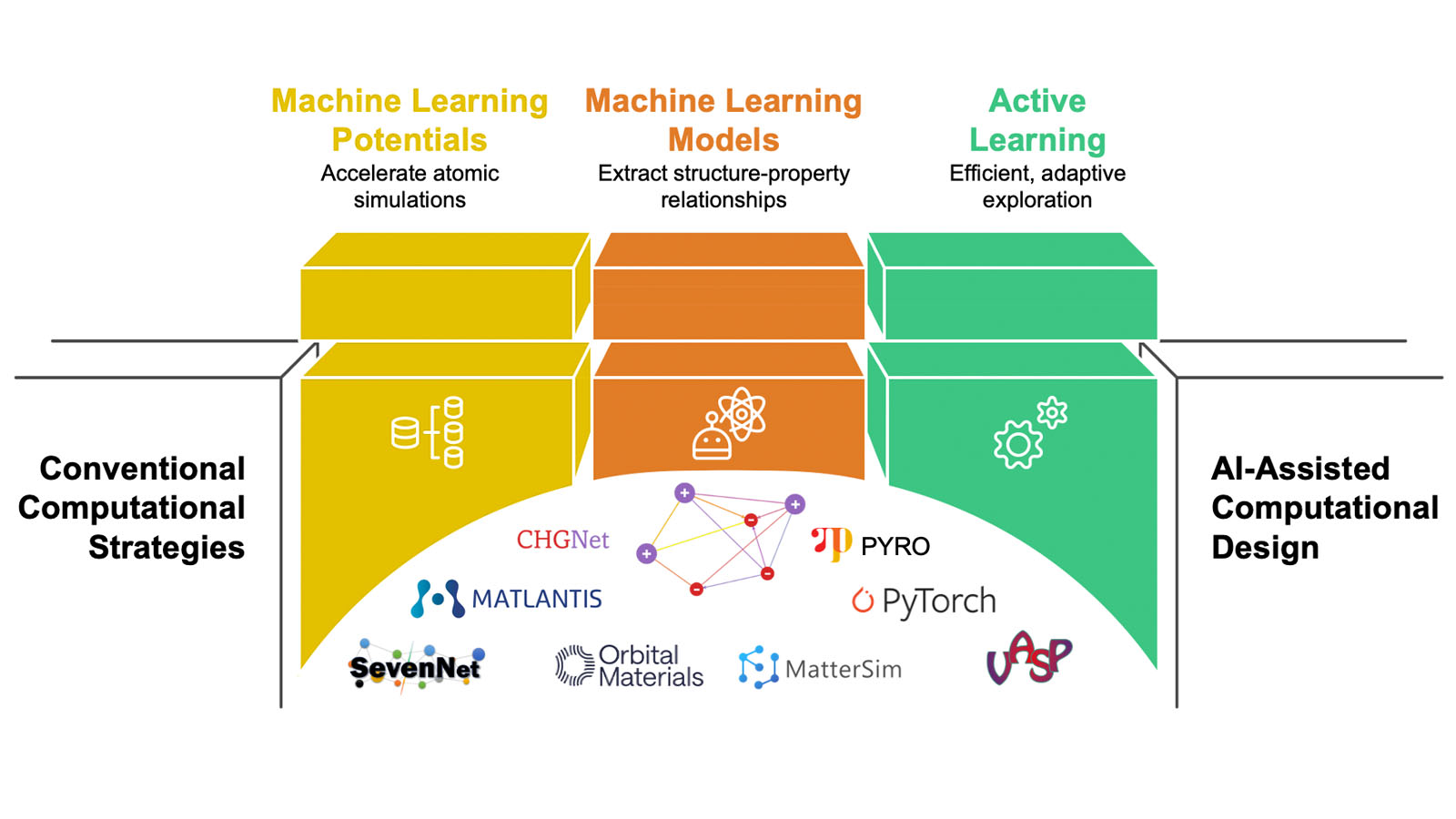
The team also develops methods to understand interfaces, where two materials meet and interact. A framework combining lattice matching, machine-learning potentials, and active learning explores how interface geometry and composition affect stability. Demonstrated using LaCoO₃/La₂NiO₄, the approach helps identify low-energy configurations relevant to energy materials. Read the study.

Making advanced simulations more accessible

Alongside these scientific advances, the group developed Masgent, an AI-assisted materials simulation agent. Masgent lets researchers use natural-language instructions to prepare simulation workflows, manipulate atomic structures, and analyze results. It brings DFT workflow tools, machine-learning-potential simulations, and data-analysis utilities into one environment, reducing the manual work required to conduct computational studies. Read the paper or explore the software.

Together, these efforts connect fundamental materials physics with practical tools for discovery. By making calculations more scalable and workflows easier to use, the group helps researchers select stronger candidates for laboratory testing and investigate materials for energy conversion, advanced alloys, and manufacturing.


Yu Zhong
Yu Zhong is a Professor in the Department of Mechanical and Materials Engineering at Worcester Polytechnic Institute. His research combines computational thermodynamics, first-principles calculations, machine learning, and experimental investigation to guide materials and process design.

Principal Members

Yale

Featured Projects

A Cooler Quantum Future
SC25 Project
A Safer Way to See Inside Cells
Accelerating Materials Innovation with DFT, CALPHAD, and AI
Adaptive Deep Learning Systems Towards Edge Intelligence
SC25 Project
AI for Cancer Diagnosis
SC25 Project
AI Pareidolia
AI-powered Performance Analytics for HPC Systems
Asking Planetary Whatifs
SC25 Project
Better Pathogen Targeting
Research Computing Center
BU Research Computing Services
Building Bicontinuous Materials
SC25 Project
Building for Floods
Computation + Machine Intelligence | Wu Tsai Institute
SC25 Project
Computing Hidden Health Threats from Heat
Computing Ocean Carbon Removal
Computing the Geometry of Frustration
Dartmouth Chat
From Murmurations to Music: Turning Bird Flight into Climate Stories
Generations of Discovery
Research Computing Center
Harvard FASRC
IceCube: Hunting Neutrinos
Imaging at Light Speed
Impact of Marine Heatwaves on Coral Diversity
Inside the Ocean's Response to Hurricanes
Learning Beyond Attention
Research Computing Center
Lincoln Laboratory Supercomputing Center (LLSC)
Mapping the Universe with AI and Supercomputing
Materials Remember
Materials That Give
SC25 Project MGHPCC Project
MGHPCC AI Computing Resource (AICR)
MGHPCC and Internet2
MGHPCC and Northern Crossroads
MGHPCC and the Campus Research Computing Consortium
MGHPCC and the IEEE High Performance Computing Conference
MGHPCC and the Massachusetts AI Hub
MGHPCC Project
MGHPCC and the National Data Platform
MGHPCC and the Northeast Research and Education Network
SC25 Project MGHPCC Project
MGHPCC and the Open Storage Network
MGHPCC Project
MGHPCC and the Prototype National Research Platform (PNRP)
Research Computing Center
MIT Office of Research Computing and Data
MIT Supercloud
Modeling an Atmospheric Detergent
SC25 Project
Multifunctional 3D-Printed Materials
SC25 Project
Naval and Ocean Renewable Energy Hydrodynamics
Research Computing Center
NEU Research Computing
SC25 Project
New Insights on Binary Black Holes
Northeast Storage Exchange
Precision Molecular Editing
Reading Night Light
SC25 Project
ReMIND
Revolutionizing Materials Design with Computational Modeling
Rhode Island INBRE Molecular Informatics Core (MIC)
SC25 Project
Sailing the Symbiosis Seascape
Seeing Ocean Currents with AI
SC25 Project
Shining a Light on Dark Matter
Simulating Large Biomolecular Assemblies
Smarter Protein Engineering
Software for Unreliable Quantum Computers
SC25 Project
Staving off the Banana Apocalypse
Supercomputing the Arctic
SC25 Project
Supporting Data-intensive Social Science
The Budget Lab
The Institute for Experiential AI
The Kempner Institute - Unlocking Intelligence
The US ATLAS Northeast Tier 2 Center
Towards a Self-driving Lab?
Tracking Earth's Atmospheric Highways
SC25 Project
Tracking Environmental Health Risks
Research Computing Center
UMass - URI Unity Cluster
Research Computing Center
UMass Amherst Research Computing and Data
Unlocking Non-coding DNA
Research Computing Center
URI Institute for AI & Computational Research
Virtual Materials Discovery at Scale
Watering MIT's AI Garden
SC25 Project
Wrangle Range Modeling
Yale Center for Genome Analysis (YCGA)
Research Computing Center
Yale Center for Research Computing
100 Bigelow Street, Holyoke, MA 01040