Welcome to the MGHPCC Virtual Booth

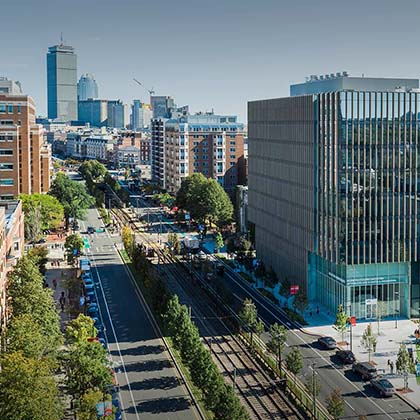
Boston University

ReMIND

Image Courtesy of the Researchers
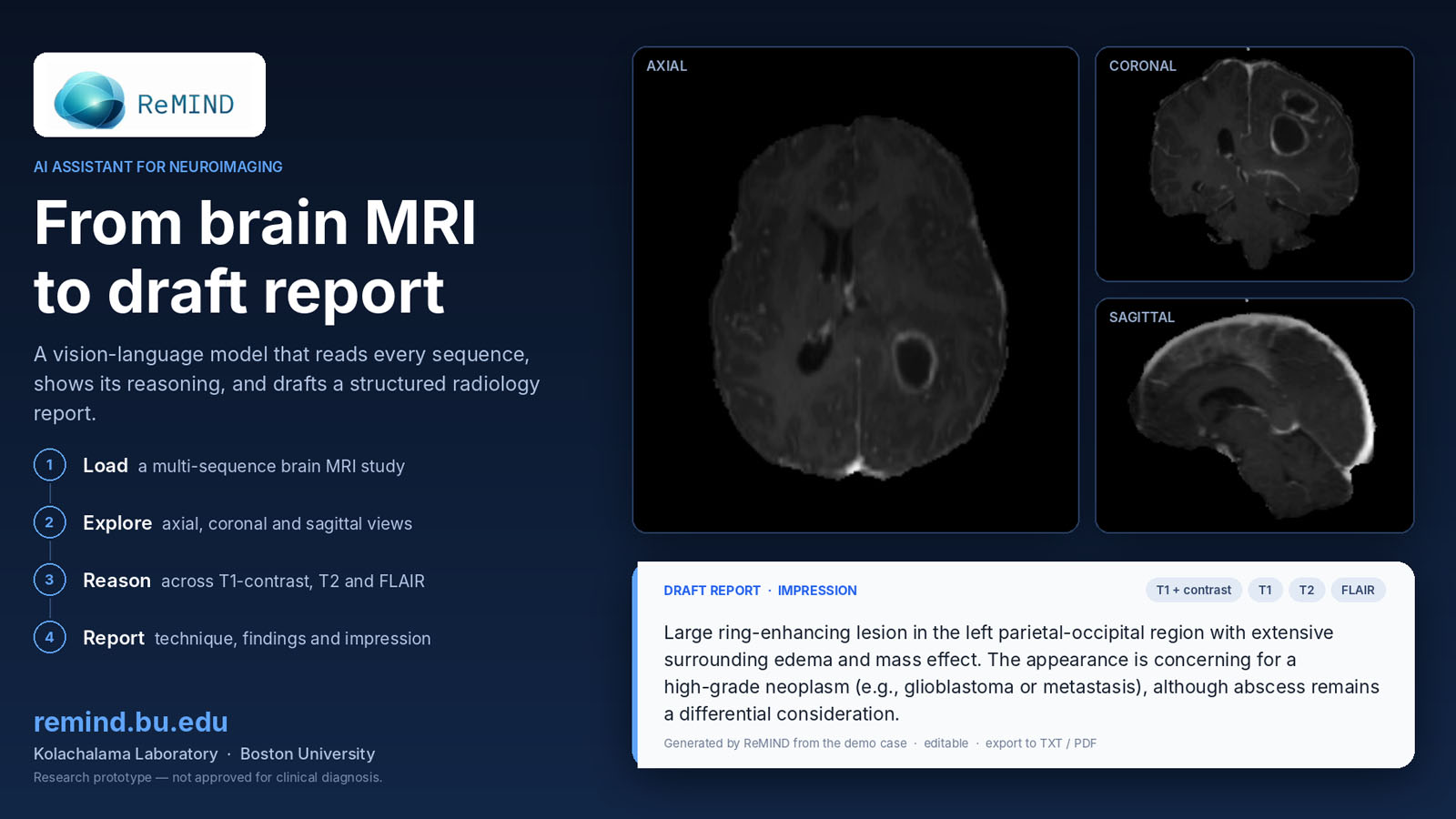
A new AI tool from the Kolachalama Lab interprets brain MRI scans and generates reports to support faster, more efficient neuroimaging analysis.
Reading brain MRI scans is a highly specialized task that requires experts to synthesize information from multiple imaging sequences and translate their observations into accurate clinical reports. As the volume of medical imaging continues to grow, researchers are exploring how artificial intelligence can help clinicians review scans more efficiently while maintaining high standards of accuracy and transparency.
To address this challenge, Boston University researcher Vijaya B. Kolachalama and his team developed ReMIND (Radiology–encoded Multimodal Interpretation for Neurological Disorders), a vision-language AI system built for neuroimaging. Rather than analyzing a single image at a time, ReMIND combines information from different types of MRI sequences, much like a radiologist does when examining a patient’s images. The system then generates structured draft reports and allows users to ask follow-up questions about findings and potential diagnoses.
ReMIND was trained and validated using more than 75,000 brain MRI visits, 850,000 imaging sequences, and over one million clinical question-and-answer pairs drawn from diverse clinical and research cohorts. By combining advanced AI with medical expertise, the project aims to make neuroimaging analysis more scalable, consistent, and accessible for research and clinical workflows.
BU’s research computing infrastructure enabled the large-scale model development, data processing, and validation work required to build and test a sophisticated AI system capable of reasoning across complex imaging datasets.

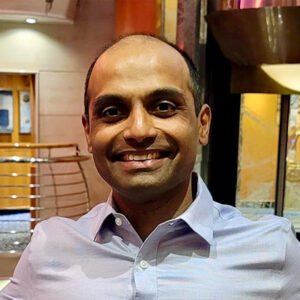
Vijaya B. Kolachalama, Ph.D.
The Kolachalama Laboratory develops artificial intelligence technologies that help clinicians interpret complex medical data. One of their flagship projects, ReMIND, is a vision-language AI system designed to analyze brain MRIs and generate radiology-style findings, reports, and explanations.

Principal Members

Yale

Featured Projects

A Cooler Quantum Future
SC25 Project
A Safer Way to See Inside Cells
Accelerating Materials Innovation with DFT, CALPHAD, and AI
Adaptive Deep Learning Systems Towards Edge Intelligence
SC25 Project
AI for Cancer Diagnosis
SC25 Project
AI Pareidolia
AI-powered Performance Analytics for HPC Systems
Asking Planetary Whatifs
SC25 Project
Better Pathogen Targeting
Research Computing Center
BU Research Computing Services
Building Bicontinuous Materials
SC25 Project
Building for Floods
Computation + Machine Intelligence | Wu Tsai Institute
SC25 Project
Computing Hidden Health Threats from Heat
Computing Ocean Carbon Removal
Computing the Geometry of Frustration
Dartmouth Chat
Developing Advanced Materials for a Sustainable Energy Future
From Murmurations to Music: Turning bird flight into climate stories
Generations of Discovery
Research Computing Center
Harvard FASRC
IceCube: Hunting Neutrinos
Imaging at Light Speed
Impact of Marine Heatwaves on Coral Diversity
Inside the Ocean's Response to Hurricanes
Learning Beyond Attention
Research Computing Center
Lincoln Laboratory Supercomputing Center (LLSC)
Mapping the Universe with AI and Supercomputing
Materials Remember
Materials That Give
SC25 Project MGHPCC Project
MGHPCC AI Computing Resource (AICR)
MGHPCC and Internet2
MGHPCC and Northern Crossroads
MGHPCC and the Campus Research Computing Consortium
MGHPCC and the IEEE High Performance Computing Conference
MGHPCC and the Massachusetts AI Hub
MGHPCC Project
MGHPCC and the National Data Platform
MGHPCC and the Northeast Research and Education Network
SC25 Project MGHPCC Project
MGHPCC and the Open Storage Network
MGHPCC Project
MGHPCC and the Prototype National Research Platform (PNRP)
MGHPCC Supercloud
SC25 Project
Microplastic-Free by Design
Research Computing Center
MIT Office of Research Computing and Data
Modeling an Atmospheric Detergent
SC25 Project
Multifunctional 3D-Printed Materials
SC25 Project
Naval and Ocean Renewable Energy Hydrodynamics
Research Computing Center
NEU Research Computing
SC25 Project
New Insights on Binary Black Holes
Northeast Storage Exchange
Precision Molecular Editing
Reading Night Light
SC25 Project
ReMIND
Revolutionizing Materials Design with Computational Modeling
Rhode Island INBRE Molecular Informatics Core (MIC)
SC25 Project
Sailing the Symbiosis Seascape
Seeing Ocean Currents with AI
SC25 Project
Shining a Light on Dark Matter
Simulating Large Biomolecular Assemblies
Smarter Protein Engineering
Software for Unreliable Quantum Computers
Solving a Physics Mystery with Supercomputing
SC25 Project
Staving off the Banana Apocalypse
Supercomputing the Arctic
SC25 Project
Supporting Data-intensive Social Science
The Kempner Institute - Unlocking Intelligence
The US ATLAS Northeast Tier 2 Center
Towards a Self-driving Lab?
Tracking Earth's Atmospheric Highways
Research Computing Center
UMass - URI Unity Cluster
Research Computing Center
UMass Amherst Research Computing and Data
Unlocking Non-coding DNA
Research Computing Center
URI Institute for AI & Computational Research
Virtual Materials Discovery at Scale
Watering MIT's AI Garden
SC25 Project
Wrangle Range Modeling
Yale Budget Lab
Yale Center for Genome Analysis (YCGA)
Research Computing Center
Yale Center for Research Computing
100 Bigelow Street, Holyoke, MA 01040