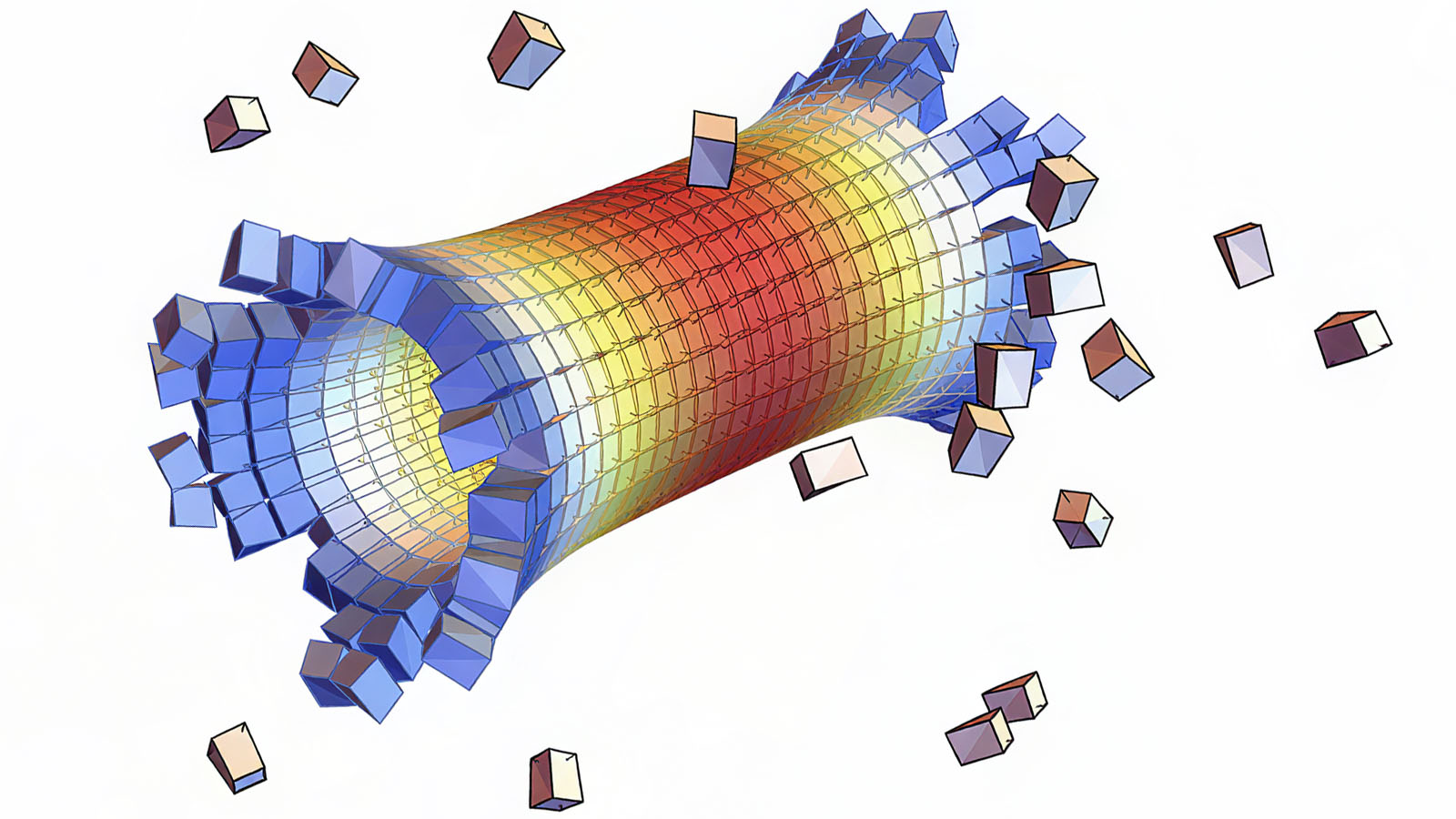
Biological membranes and synthetic vesicles (small membrane-bound sacs) often contain regions that behave like thin, elastic solids embedded within otherwise fluid surfaces. Predicting how these solid patches deform is a major scientific challenge because two competing forces are at work: the membrane naturally wants to adopt smooth curved shapes, while the solid domain resists stretching and bending. This geometric conflict, known as frustration, can generate surprisingly complex structures.
In this study, UMass Amherst researchers used advanced computational modeling to explore how a solid circular domain behaves when attached to a closed membrane vesicle. Their simulations revealed a rich sequence of shape transitions as the vesicle inflates. Depending on membrane tension and material properties, the solid region can roll, fold, crumple, wrinkle, or ultimately smooth into a cap-like shape. The work identifies the key physical mechanisms that control these transitions and shows strong agreement with experimentally observed lipid vesicles.
The findings provide new insight into how complex structures emerge in biological membranes and soft materials. Beyond explaining laboratory observations, the results offer design principles for engineered vesicles, responsive materials, and membrane-based systems whose shape and function can be controlled through geometry and mechanics.
UMass research computing enabled the large-scale finite-element simulations needed to map these intricate shape behaviors and connect theory with experiment.
Jeon, G., Prempeh, A. N. A., Santore, M. M., & Grason, G. M. (2026), Frustrated Shapes of Solid Domains in Fluid Membrane Vesicles: From Rolls and Folds to Crumples and Wrinkles, arXiv:2606.26433