Welcome to the MGHPCC Virtual Booth

University of Rhode Island

Inside the Ocean's Response to Hurricanes

Credit: Isaac Ginis
URI researchers use MGHPCC-powered simulations to reveal how ocean currents reduce hurricane wave heights.

Hurricanes generate enormous ocean waves that can threaten ships, offshore infrastructure, and coastal communities. Accurately predicting wave height and behavior is therefore essential for weather forecasting and hazard preparedness. Yet scientists have long known that hurricane-driven ocean currents interact with surface waves in complex ways that are difficult to capture in forecast models.

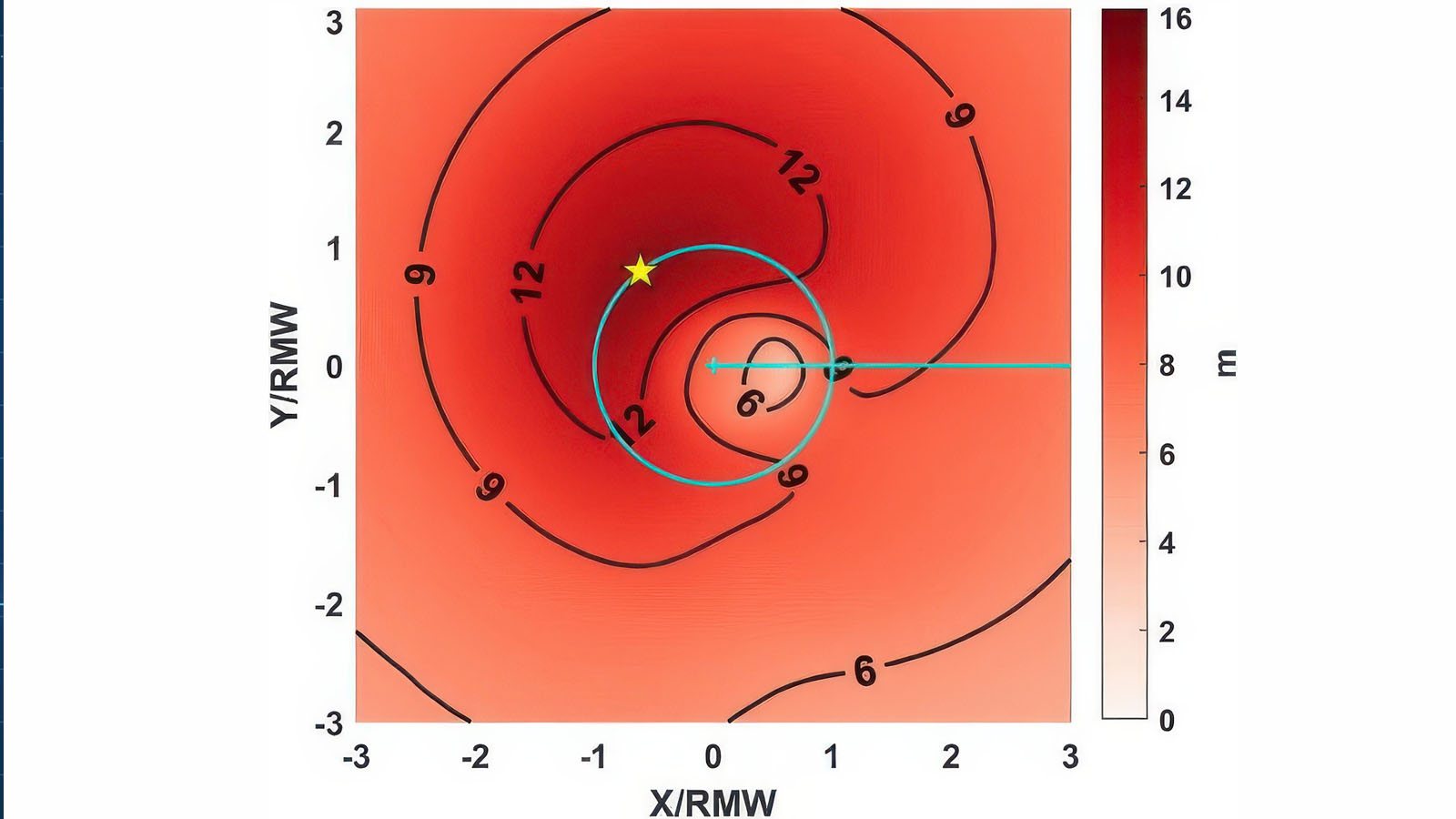
Researchers at the University of Rhode Island's Hurricane Research Lab used advanced computer simulations to investigate how strong ocean currents influence waves during hurricanes. Led by Isaac Ginis, the team discovered that hurricane-generated currents can significantly reduce both the height and the dominant period of surface waves. In some cases, the simulations showed reductions of up to 2.2 meters (about seven feet) in significant wave height. The researchers found that the strongest effects occur on the front-right side of a hurricane, where winds, waves, and currents move in the same direction. Because the currents accelerate the waves through the storm, the waves spend less time gaining energy from the wind and therefore do not grow as large.

The findings could improve operational hurricane forecasting and provide more accurate estimates of ocean conditions during storms. Using high-performance computing resources available through URI's partnership with the MGHPCC, the researchers were able to perform the sophisticated coupled ocean-wave simulations needed to reveal these effects. Their work may ultimately help weather agencies deliver better forecasts and support safer decisions during dangerous storms.

Publication

Papandreou, A., Hara, T., & Ginis, I. (2026), Computer simulations show strong ocean currents reduce size of surface waves, Journal of Physical Oceanography, doi: 10.1175/JPO-D-25-0137.1
Isaac Ginis
Professor Emeritus Isaac Ginis is a physical oceanographer specializing in air-sea interactions, tropical cyclones, and environmental modeling, whose work helped develop operational hurricane forecast systems used by major U.S. weather agencies.

Principal Members

Yale

Featured Projects

A Cooler Quantum Future
SC25 Project
A Safer Way to See Inside Cells
Accelerating Materials Innovation with DFT, CALPHAD, and AI
Adaptive Deep Learning Systems Towards Edge Intelligence
SC25 Project
AI for Cancer Diagnosis
SC25 Project
AI Pareidolia
AI-powered Performance Analytics for HPC Systems
Asking Planetary Whatifs
SC25 Project
Better Pathogen Targeting
Research Computing Center
BU Research Computing Services
Building Bicontinuous Materials
SC25 Project
Building for Floods
Computation + Machine Intelligence | Wu Tsai Institute
SC25 Project
Computing Hidden Health Threats from Heat
Computing Ocean Carbon Removal
Computing the Geometry of Frustration
Dartmouth Chat
Developing Advanced Materials for a Sustainable Energy Future
From Murmurations to Music: Turning bird flight into climate stories
Generations of Discovery
Research Computing Center
Harvard FASRC
IceCube: Hunting Neutrinos
Imaging at Light Speed
Impact of Marine Heatwaves on Coral Diversity
Inside the Ocean's Response to Hurricanes
Learning Beyond Attention
Research Computing Center
Lincoln Laboratory Supercomputing Center (LLSC)
Mapping the Universe with AI and Supercomputing
Materials Remember
Materials That Give
SC25 Project MGHPCC Project
MGHPCC AI Computing Resource (AICR)
MGHPCC and Internet2
MGHPCC and Northern Crossroads
MGHPCC and the Campus Research Computing Consortium
MGHPCC and the IEEE High Performance Computing Conference
MGHPCC and the Massachusetts AI Hub
MGHPCC Project
MGHPCC and the National Data Platform
MGHPCC and the Northeast Research and Education Network
SC25 Project MGHPCC Project
MGHPCC and the Open Storage Network
MGHPCC Project
MGHPCC and the Prototype National Research Platform (PNRP)
MGHPCC Supercloud
SC25 Project
Microplastic-Free by Design
Research Computing Center
MIT Office of Research Computing and Data
Modeling an Atmospheric Detergent
SC25 Project
Multifunctional 3D-Printed Materials
SC25 Project
Naval and Ocean Renewable Energy Hydrodynamics
Research Computing Center
NEU Research Computing
SC25 Project
New Insights on Binary Black Holes
Northeast Storage Exchange
Precision Molecular Editing
Reading Night Light
SC25 Project
ReMIND
Revolutionizing Materials Design with Computational Modeling
Rhode Island INBRE Molecular Informatics Core (MIC)
SC25 Project
Sailing the Symbiosis Seascape
Seeing Ocean Currents with AI
SC25 Project
Shining a Light on Dark Matter
Simulating Large Biomolecular Assemblies
Smarter Protein Engineering
Software for Unreliable Quantum Computers
Solving a Physics Mystery with Supercomputing
SC25 Project
Staving off the Banana Apocalypse
Supercomputing the Arctic
SC25 Project
Supporting Data-intensive Social Science
The Kempner Institute - Unlocking Intelligence
The US ATLAS Northeast Tier 2 Center
Towards a Self-driving Lab?
Tracking Earth's Atmospheric Highways
Research Computing Center
UMass - URI Unity Cluster
Research Computing Center
UMass Amherst Research Computing and Data
Unlocking Non-coding DNA
Research Computing Center
URI Institute for AI & Computational Research
Virtual Materials Discovery at Scale
Watering MIT's AI Garden
SC25 Project
Wrangle Range Modeling
Yale Budget Lab
Yale Center for Genome Analysis (YCGA)
Research Computing Center
Yale Center for Research Computing
100 Bigelow Street, Holyoke, MA 01040