Welcome to the MGHPCC Virtual Booth

University of Rhode Island

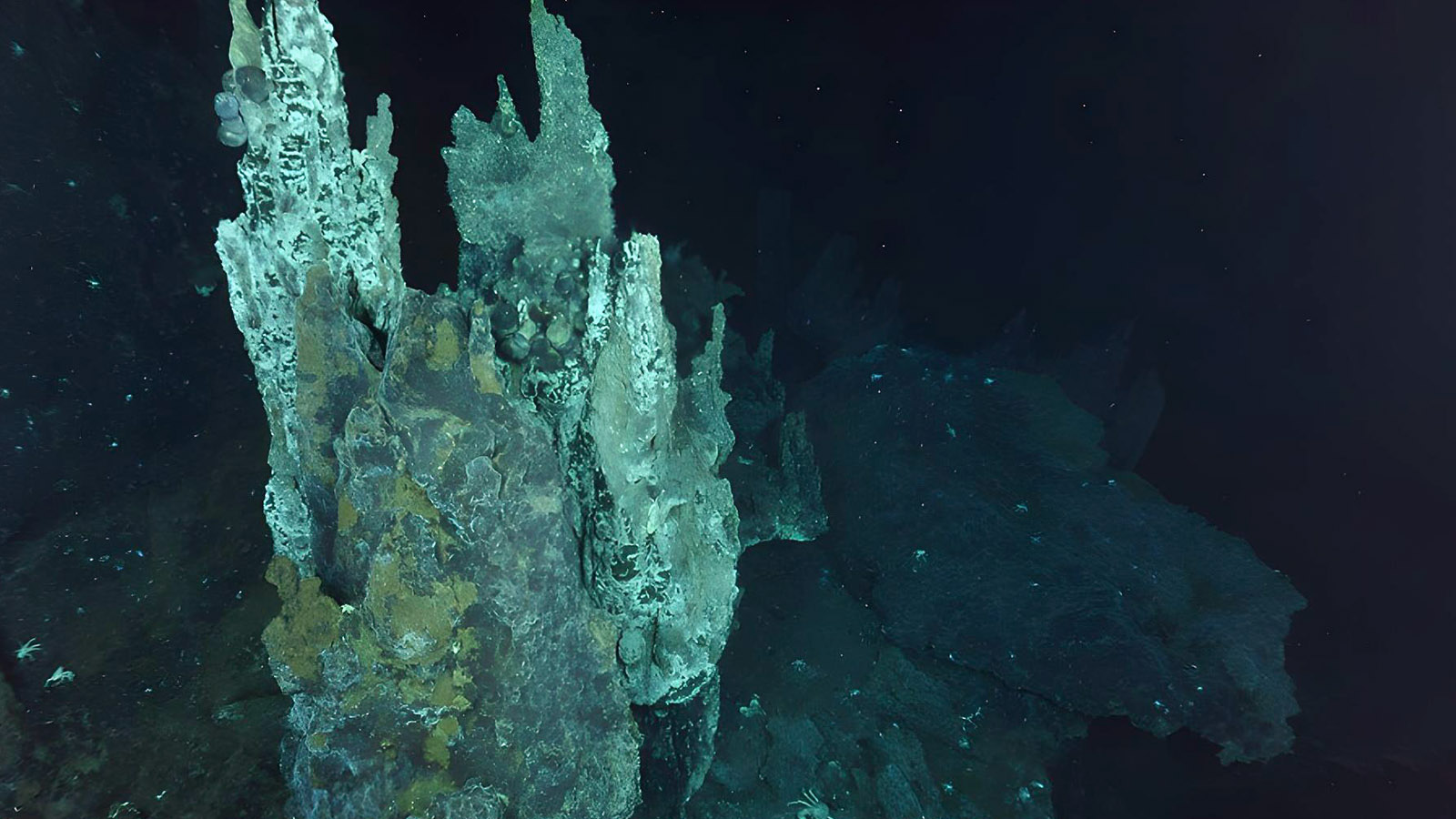
Sailing the Symbiosis Seascape

Researchers in the Beinart Lab at URI use genomic approaches to understand host-associated microbiomes in the ocean.

Most marine organisms host microbes that are essential to their health, ecology, and evolution. For species living in extreme environments—such as oxygen-depleted “dead zones” or deep-sea hydrothermal vents—these microbial partnerships can be vital for survival. Research in the Beinart Lab at the University of Rhode Island uses advanced genomic techniques to reveal how microbes interact with marine animals and with each other through symbiosis, particularly in these challenging oceanic habitats. This work enhances our understanding of the role and significance of microbes in sustaining marine ecosystems.

A recent study from the lab investigates the evolutionary impact of the 2022 Hunga volcanic eruption on hydrothermal vent communities in the Southwest Pacific. Researchers analyzed mollusk-microbial symbioses from the Lau Basin using metagenomic sequencing to compare pre- and post-eruption genetic data. They found that while animal host populations showed minimal changes in genome-wide diversity, they experienced a long-term decline in effective population size, likely exacerbated by the eruption. In contrast, microbial symbionts exhibited a significant loss in genomic variation, including the disappearance of habitat-specific strains. However, environmental DNA evidence suggests that some strain diversity may be recoverable from free-living microbial pools.

Their work relied heavily on high-performance computing (HPC) resources provided by MGHPCC to process and analyze large-scale genomic datasets. Computational workflows included genome assembly, variant calling, and population genetics modeling, enabling the team to detect subtle evolutionary signals across complex symbiotic systems. The study highlights the critical role of research computing in understanding ecological resilience and evolutionary dynamics in extreme environments.
Roxanne Beinart
Associate Professor of Oceanography University of Rhode Island Graduate School of Oceanography

Principal Members

Yale

Featured Projects

A complicated future for a methane-cleansing molecule (working title)
SC25 Project
A Safer Way to See Inside Cells
Adaptive Deep Learning Systems Towards Edge Intelligence
SC25 Project
AI for Cancer Diagnosis
SC25 Project
AI Pareidolia
SC25 Project
AI That Speaks Human About Health
Ancient DNA reveals pervasive directional selection across West Eurasia (working title)
Bayesian Deep Gaussian Processes for Correlated Functional Data (working title)
SC25 Project
Better Pathogen Targeting
Research Computing Center
BU Research Computing Services
SC25 Project
Building for Floods
Campus Research Computing Consortium
Cellular Protein Electrochemical Balance (working title)
Combining AI with laboratory evolution yields improved proteins (working title)
Computation + Machine Intelligence | Wu Tsai Institute
Computational Modeling of Biological Systems
Computer Simulatioons Show Strong Ocean Currents Reduce Size of Surface Waves (working title)
SC25 Project
Computing Hidden Health Threats from Heat
Contribution of Task-Irrelevant Stimuli to Drift of Neural Representations (working title)
Deciphering Alzheimer's Disease
Developing Advanced Materials for a Sustainable Energy Future
Earth & Planetary Sciences at Harvard University
MGHPCC Project
Ecosystem for Research Networking
Efficient cooling method could enable chip-based trapped-ion quantum computers (working title)
Energy Science Network
MGHPCC Project
Expanding Computing Education Pathways (ECEP) Alliance
FABRIC Testbed
SC25 Project
FlowER: AI for Predicting Chemical Reactions
SC25 Project
Grid Responsive Data Centers
Research Computing Center
Harvard FASRC
IceCube: Hunting Neutrinos
Identifying non-coding variant effects at scale via machine learning models of cis-regulatory reporter assays (working title)
IEEE High Performance Extreme Computing Conference
Impact of Marine Heatwaves on Coral Diversity
Impulse response functions as a framework for quantifying ocean-based carbon dioxide removal (working title)
Internet2
Research Computing Center
Lincoln Laboratory Supercomputing Center (LLSC)
SC25 Project MGHPCC Project
Massachusetts AI Hub
SC25 Project MGHPCC Project
MGHPCC AI Computing Resource (AICR)
MGHPCC Supercloud
SC25 Project
Microplastic-Free by Design
MIT chemists design impact-resistant plastics (working title)
Research Computing Center
MIT Office of Research Computing and Data
SC25 Project
Multifunctional 3D-Printed Materials
MGHPCC Project
National Data Platform
SC25 Project
Naval and Ocean Renewable Energy Hydrodynamics
Research Computing Center
NEU Research Computing
New MetaMaterials Take Inspiration from Deep Sea Sponges (working title)
Northeast Research and Education Network
MGHPCC Project
Northeast Storage Exchange
Northern Crossroads
Novel study at URI seeks to treat neurological symptoms of rare genetic disorder (working title)
Open Cloud Testbed
ORCD Seed Fund
SC25 Project MGHPCC Project
OSN - Open Storage Network
Planning, Reminders and Micro-Incentives to Walk After Traumatic Brain Injury: A Pilot Randomized Control Trial (working title)
MGHPCC Project
PNRP- protype national research platform
Researchers develop molecular editing tool to relocate alcohol groups (working title)
Revolutionizing Materials Design with Computational Modeling
SC25 Project
Sailing the Symbiosis Seascape
Shear-Induced Structural Convergence but Formation-History-Dependent Yielding in Sequentially Gelled Binary Colloidal Networks (working title)
SC25 Project
Shining a Light on Dark Matter
Simulating Large Biomolecular Assemblies
Single-molecule tracker illuminates workings of cancer-related proteins (working title)
Software for Unreliable Quantum Computers
SC25 Project
Staving off the Banana Apocalypse
SC25 Project
Supporting Data-intensive Social Science
The Kempner Institute - Unlocking Intelligence
The US ATLAS Northeast Tier 2 Center
This AI scientist can run an X-ray experiment. Self-driving labs may come next (working title)
SC25 Project
Tracking Environmental Health Risks
Research Computing Center
UMass - URI Unity Cluster
Research Computing Center
UMass Amherst Research Computing and Data
Unity HPC and AI Platform
Research Computing Center
URI Institute for AI & Computational Research
SC25 Project
Wrangle Range Modeling
Yale Budget Lab
Yale Center for Genome Analysis (YCGA)
Research Computing Center
Yale Center for Research Computing
Yale Department of Earth and Planetary Sciences
Zebrafish Reveal New Insights into Biology of Autism (working title)
100 Bigelow Street, Holyoke, MA 01040