Welcome to the MGHPCC Virtual Booth

Northeastern University

Building Bicontinuous Materials

Using high-performance computing, researchers discover a new pathway for creating bicontinuous materials with applications in batteries, catalysts, and advanced manufacturing.

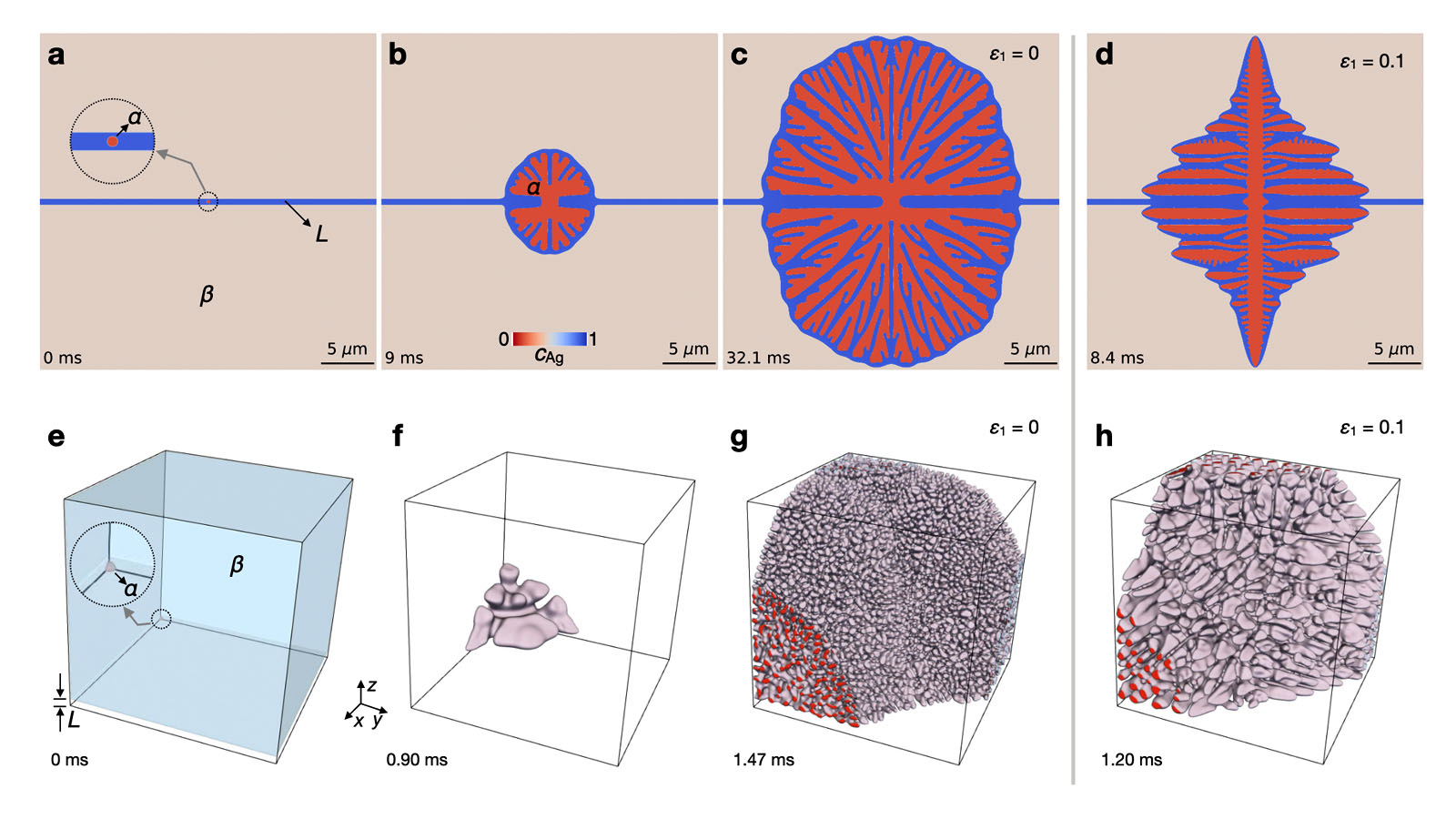
Bicontinuous materials, which contain interconnected networks of two distinct phases, are valuable for applications ranging from energy storage and catalysis to sensing and advanced manufacturing. While several dealloying techniques can create these structures, scientists have struggled to explain how bicontinuous architectures emerge during peritectic melting, a process in which an alloy melts and reorganizes internally without an external chemical bath. Experimental studies of titanium-silver (Ti-Ag) alloys had observed the formation of these intricate structures, but the underlying mechanism remained unknown.

Using large-scale phase-field simulations, Northeastern researchers uncovered the physical process responsible. The team showed that a thin liquid layer formed during melting becomes morphologically unstable, causing a titanium-rich phase to grow into complex branched structures. As neighboring branches expand, they merge and form interconnected "handles," gradually transforming the material into a highly connected bicontinuous network. Their simulations also revealed fundamental scaling laws that govern how quickly these structures form and how their characteristic dimensions evolve over time. The researchers validated these observations with a new theoretical framework that accurately predicts the behavior seen in the simulations.

The discovery establishes peritectic melting as a fundamentally distinct pathway for creating bicontinuous materials and provides new principles for controlling microstructure during alloy processing. By showing how grain size and ligament size can be independently tuned, the work could help accelerate the design of next-generation materials for batteries, catalysts, structural components, and other energy-related technologies.

Northeastern's research computing infrastructure was essential to the effort, enabling demanding three-dimensional simulations and topological analyses that revealed mechanisms impossible to observe directly in experiments.

Paper

Zhong, M., & Karma, A. (2026), Dealloying by peritectic melting, arXiv:2605.25834

Alain Karma
Physisict Alain Karma develops mathematical and computational models to understand complex pattern formation in materials and biological systems. His lab is particularly known for pioneering phase-field simulation methods that reveal how microscopic processes shape the structure and properties of advanced materials.

Principal Members

Yale

Featured Projects

A Cooler Quantum Future
SC25 Project
A Safer Way to See Inside Cells
Accelerating Materials Innovation with DFT, CALPHAD, and AI
Adaptive Deep Learning Systems Towards Edge Intelligence
SC25 Project
AI for Cancer Diagnosis
SC25 Project
AI Pareidolia
AI-powered Performance Analytics for HPC Systems
Asking Planetary Whatifs
SC25 Project
Better Pathogen Targeting
Research Computing Center
BU Research Computing Services
Building Bicontinuous Materials
SC25 Project
Building for Floods
Computation + Machine Intelligence | Wu Tsai Institute
SC25 Project
Computing Hidden Health Threats from Heat
Computing Ocean Carbon Removal
Computing the Geometry of Frustration
Dartmouth Chat
Developing Advanced Materials for a Sustainable Energy Future
From Murmurations to Music: Turning bird flight into climate stories
Generations of Discovery
Research Computing Center
Harvard FASRC
IceCube: Hunting Neutrinos
Imaging at Light Speed
Impact of Marine Heatwaves on Coral Diversity
Inside the Ocean's Response to Hurricanes
Learning Beyond Attention
Research Computing Center
Lincoln Laboratory Supercomputing Center (LLSC)
Mapping the Universe with AI and Supercomputing
Materials Remember
Materials That Give
SC25 Project MGHPCC Project
MGHPCC AI Computing Resource (AICR)
MGHPCC and Internet2
MGHPCC and Northern Crossroads
MGHPCC and the Campus Research Computing Consortium
MGHPCC and the IEEE High Performance Computing Conference
MGHPCC and the Massachusetts AI Hub
MGHPCC Project
MGHPCC and the National Data Platform
MGHPCC and the Northeast Research and Education Network
SC25 Project MGHPCC Project
MGHPCC and the Open Storage Network
MGHPCC Project
MGHPCC and the Prototype National Research Platform (PNRP)
MGHPCC Supercloud
SC25 Project
Microplastic-Free by Design
Research Computing Center
MIT Office of Research Computing and Data
Modeling an Atmospheric Detergent
SC25 Project
Multifunctional 3D-Printed Materials
SC25 Project
Naval and Ocean Renewable Energy Hydrodynamics
Research Computing Center
NEU Research Computing
SC25 Project
New Insights on Binary Black Holes
Northeast Storage Exchange
Precision Molecular Editing
Reading Night Light
SC25 Project
ReMIND
Revolutionizing Materials Design with Computational Modeling
Rhode Island INBRE Molecular Informatics Core (MIC)
SC25 Project
Sailing the Symbiosis Seascape
Seeing Ocean Currents with AI
SC25 Project
Shining a Light on Dark Matter
Simulating Large Biomolecular Assemblies
Smarter Protein Engineering
Software for Unreliable Quantum Computers
Solving a Physics Mystery with Supercomputing
SC25 Project
Staving off the Banana Apocalypse
Supercomputing the Arctic
SC25 Project
Supporting Data-intensive Social Science
The Kempner Institute - Unlocking Intelligence
The US ATLAS Northeast Tier 2 Center
Towards a Self-driving Lab?
Tracking Earth's Atmospheric Highways
Research Computing Center
UMass - URI Unity Cluster
Research Computing Center
UMass Amherst Research Computing and Data
Unlocking Non-coding DNA
Research Computing Center
URI Institute for AI & Computational Research
Virtual Materials Discovery at Scale
Watering MIT's AI Garden
SC25 Project
Wrangle Range Modeling
Yale Budget Lab
Yale Center for Genome Analysis (YCGA)
Research Computing Center
Yale Center for Research Computing
100 Bigelow Street, Holyoke, MA 01040