Welcome to the MGHPCC Virtual Booth

Boston University

Imaging at Light Speed

Novel microscopy approach combines event cameras, computational imaging, and AI to capture ultrafast 3D biological processes with unprecedented speed and resolution.

Capturing fast biological activity in three dimensions is a longstanding challenge in microscopy. Traditional high-resolution imaging systems often rely on scanning techniques that collect information sequentially, creating a trade-off between image quality, field of view, and speed. As a result, many important biological events, including neural signaling, blood-flow dynamics, and rapid cellular motion, can occur faster than conventional imaging systems can accurately record.

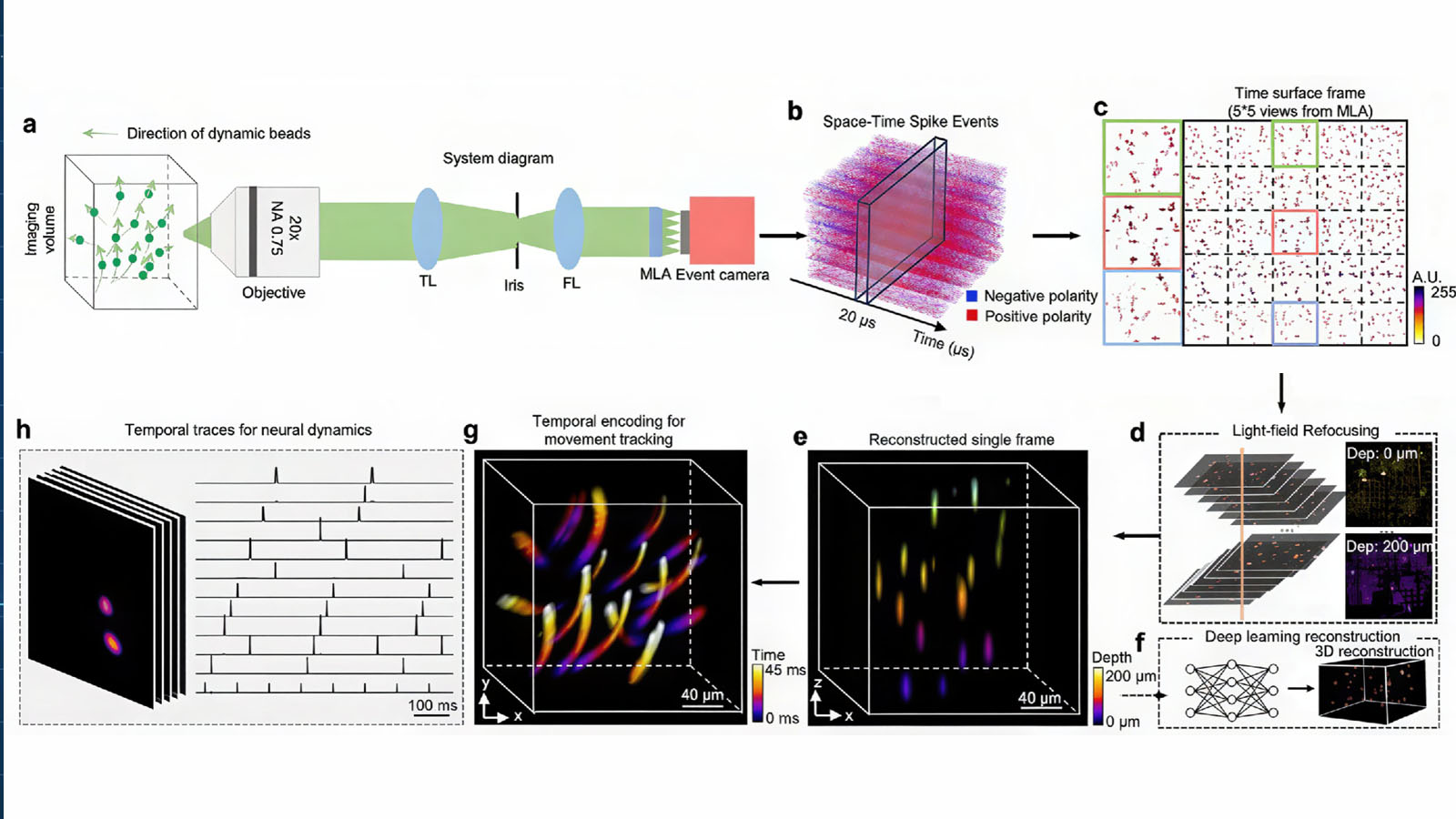
Computational Imaging Systems Lab researchers at BU have developed a new approach called EventLFM (Event Camera Integrated Fourier Light Field Microscopy) to overcome this limitation. The technology combines a specialized event camera with Fourier light field microscopy, enabling researchers to reconstruct three-dimensional biological activity at kilohertz-scale speeds. Unlike conventional cameras that repeatedly capture full images, event cameras record only changes in brightness, dramatically increasing temporal resolution while reducing redundant data collection.

Using EventLFM, the team demonstrated the ability to image rapidly blinking neuronal signals in scattering mouse brain tissue and to track fluorescently labeled neurons in freely moving C. elegans at hundreds to thousands of frames per second. The researchers also incorporated deep-learning-based reconstruction methods that improved image quality and enhanced 3D resolution.

The advance provides scientists with a powerful new tool for observing dynamic biological processes that were previously difficult or impossible to visualize. BU research computing resources were central to the achievement, enabling event-stream processing, computational image reconstruction, deep neural network enhancement, and large-scale analysis of high-speed volumetric imaging data.

Select Publications

Guo R, Yang Q, Chang AS, Hu G, Greene J, Gabel CV, You S, Tian L. (2024), Event camera integrated Fourier light field microscopy for ultrafast 3D imaging, Light: Science & Applications, doi: 10.1038/s41377-024-01502-5

Ruipeng Guo, Xueli Pan, Qilin Deng, Abrar Ahmed, Qianwan Yang, Joseph Greene, Tongyu Li, Suet Ying Chan, Zhixiong Chen, Guorong Hu, Hui Feng, and Lei Tian (2026), Dual-channel event microscopy for ultrafast biological imaging, PNAS, doi: 10.1073/pnas.2531386123
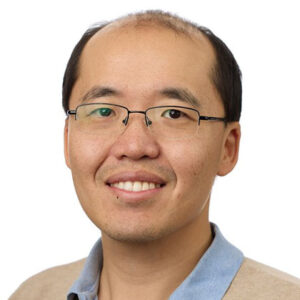
Lei Tian, PhD
Led by Lei Tian, PhD, an Associate Professor inBU's College of Engineering, the Computational Imaging Systems Lab develops next-generation imaging technologies that combine physics, optics, computation, and artificial intelligence. The lab creates intelligent optical systems that can measure complex biological and physical processes in unprecedented detail, with applications ranging from neuroscience and cancer research to semiconductor inspection.

Principal Members

Yale

Featured Projects

A Cooler Quantum Future
SC25 Project
A Safer Way to See Inside Cells
Accelerating Materials Innovation with DFT, CALPHAD, and AI
Adaptive Deep Learning Systems Towards Edge Intelligence
SC25 Project
AI for Cancer Diagnosis
SC25 Project
AI Pareidolia
AI-powered Performance Analytics for HPC Systems
Asking Planetary Whatifs
SC25 Project
Better Pathogen Targeting
Research Computing Center
BU Research Computing Services
Building Bicontinuous Materials
SC25 Project
Building for Floods
Computation + Machine Intelligence | Wu Tsai Institute
SC25 Project
Computing Hidden Health Threats from Heat
Computing Ocean Carbon Removal
Computing the Geometry of Frustration
Dartmouth Chat
Developing Advanced Materials for a Sustainable Energy Future
From Murmurations to Music: Turning bird flight into climate stories
Generations of Discovery
Research Computing Center
Harvard FASRC
IceCube: Hunting Neutrinos
Imaging at Light Speed
Impact of Marine Heatwaves on Coral Diversity
Inside the Ocean's Response to Hurricanes
Learning Beyond Attention
Research Computing Center
Lincoln Laboratory Supercomputing Center (LLSC)
Mapping the Universe with AI and Supercomputing
Materials Remember
Materials That Give
SC25 Project MGHPCC Project
MGHPCC AI Computing Resource (AICR)
MGHPCC and Internet2
MGHPCC and Northern Crossroads
MGHPCC and the Campus Research Computing Consortium
MGHPCC and the IEEE High Performance Computing Conference
MGHPCC and the Massachusetts AI Hub
MGHPCC Project
MGHPCC and the National Data Platform
MGHPCC and the Northeast Research and Education Network
SC25 Project MGHPCC Project
MGHPCC and the Open Storage Network
MGHPCC Project
MGHPCC and the Prototype National Research Platform (PNRP)
MGHPCC Supercloud
SC25 Project
Microplastic-Free by Design
Research Computing Center
MIT Office of Research Computing and Data
Modeling an Atmospheric Detergent
SC25 Project
Multifunctional 3D-Printed Materials
SC25 Project
Naval and Ocean Renewable Energy Hydrodynamics
Research Computing Center
NEU Research Computing
SC25 Project
New Insights on Binary Black Holes
Northeast Storage Exchange
Precision Molecular Editing
Reading Night Light
SC25 Project
ReMIND
Revolutionizing Materials Design with Computational Modeling
Rhode Island INBRE Molecular Informatics Core (MIC)
SC25 Project
Sailing the Symbiosis Seascape
Seeing Ocean Currents with AI
SC25 Project
Shining a Light on Dark Matter
Simulating Large Biomolecular Assemblies
Smarter Protein Engineering
Software for Unreliable Quantum Computers
Solving a Physics Mystery with Supercomputing
SC25 Project
Staving off the Banana Apocalypse
Supercomputing the Arctic
SC25 Project
Supporting Data-intensive Social Science
The Kempner Institute - Unlocking Intelligence
The US ATLAS Northeast Tier 2 Center
Towards a Self-driving Lab?
Tracking Earth's Atmospheric Highways
Research Computing Center
UMass - URI Unity Cluster
Research Computing Center
UMass Amherst Research Computing and Data
Unlocking Non-coding DNA
Research Computing Center
URI Institute for AI & Computational Research
Virtual Materials Discovery at Scale
Watering MIT's AI Garden
SC25 Project
Wrangle Range Modeling
Yale Budget Lab
Yale Center for Genome Analysis (YCGA)
Research Computing Center
Yale Center for Research Computing
100 Bigelow Street, Holyoke, MA 01040