Welcome to the MGHPCC Virtual Booth

MIT | MIT Lincoln Laboratory

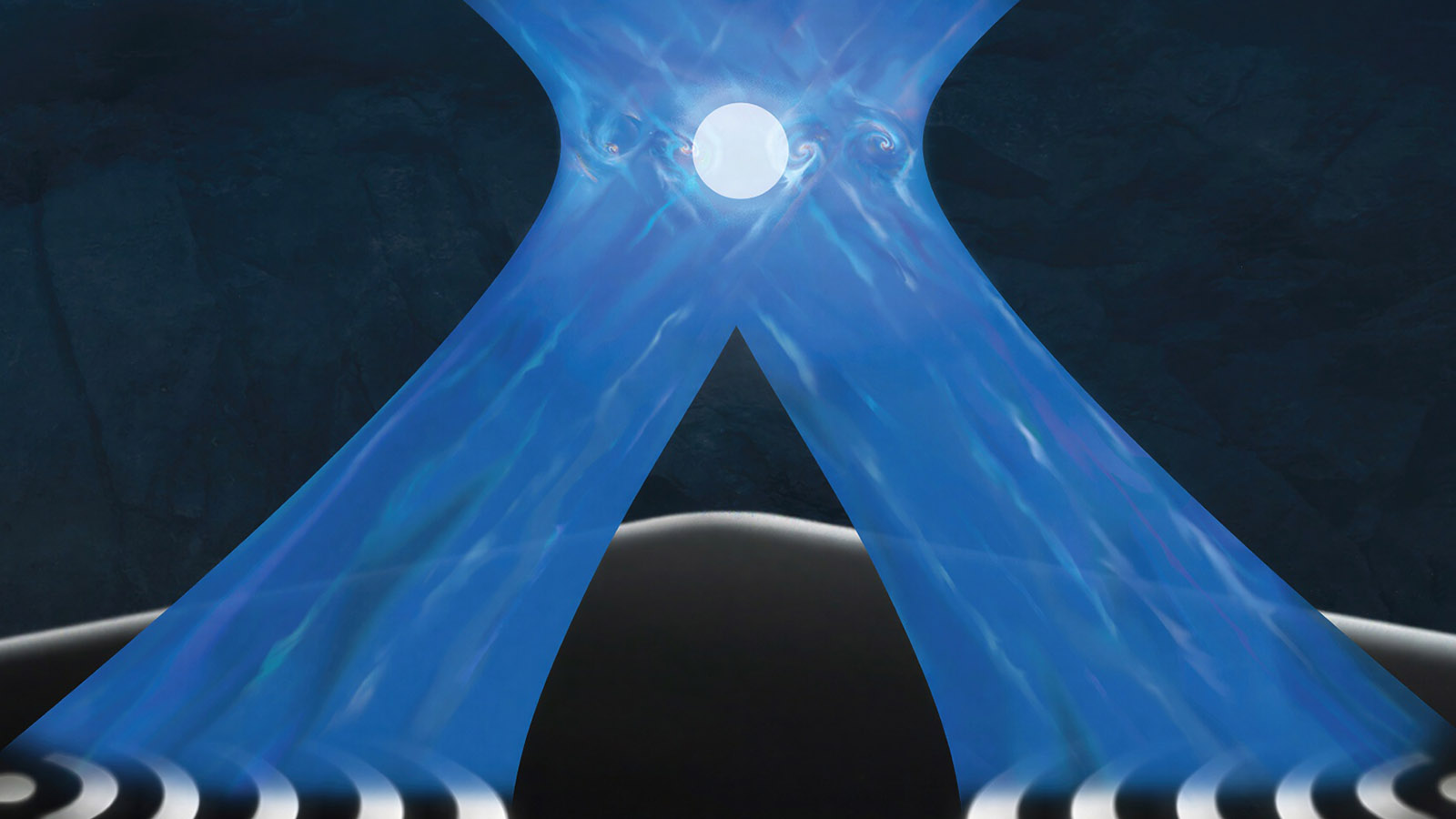
A Cooler Quantum Future

Credit: Michael Hurley and Sampson Wilcox
A new photonic-chip cooling method enables more stable trapped-ion qubits, bringing practical quantum computers closer to reality.

Quantum computers have the potential to solve scientific and engineering problems that would overwhelm even today's fastest supercomputers. But realizing that promise requires keeping quantum bits, or qubits, exceptionally stable. In trapped-ion quantum computers, qubits are formed from electrically charged atoms suspended by electromagnetic fields. Even tiny vibrations can introduce errors, making efficient cooling essential.

To address this challenge, researchers in the Notaros Group have developed a new cooling method built directly into a photonic chip. Rather than relying on large, complex optical systems, the team designed microscopic antennas that manipulate tightly focused and intersecting beams of laser light on a compact integrated device. This approach enabled trapped ions to be cooled to temperatures roughly ten times below the limit achievable with standard laser-cooling techniques.

The breakthrough represents an important step toward scalable trapped-ion quantum computers. Chip-based architectures could dramatically reduce the size and complexity of quantum systems while improving performance and manufacturability. More efficient cooling helps stabilize qubits, reducing errors and enabling more sophisticated quantum operations.

MIT's advanced computing environment played a crucial role in the design and optimization of the photonic devices. Computational modeling guided the engineering of polarization-diverse optical components and helped researchers predict how light would interact with trapped ions, accelerating the development and validation of the new architecture.
Jelena Notaros
Jelena Notaros is an MIT professor developing advanced photonic chips for high-performance computing, communications, and quantum technologies.

Principal Members

Yale

Featured Projects

A Cooler Quantum Future
SC25 Project
A Safer Way to See Inside Cells
Accelerating Materials Innovation with DFT, CALPHAD, and AI
Adaptive Deep Learning Systems Towards Edge Intelligence
SC25 Project
AI for Cancer Diagnosis
SC25 Project
AI Pareidolia
AI-powered Performance Analytics for HPC Systems
Asking Planetary Whatifs
SC25 Project
Better Pathogen Targeting
Research Computing Center
BU Research Computing Services
Building Bicontinuous Materials
SC25 Project
Building for Floods
Computation + Machine Intelligence | Wu Tsai Institute
SC25 Project
Computing Hidden Health Threats from Heat
Computing Ocean Carbon Removal
Computing the Geometry of Frustration
Dartmouth Chat
Developing Advanced Materials for a Sustainable Energy Future
From Murmurations to Music: Turning bird flight into climate stories
Generations of Discovery
Research Computing Center
Harvard FASRC
IceCube: Hunting Neutrinos
Imaging at Light Speed
Impact of Marine Heatwaves on Coral Diversity
Inside the Ocean's Response to Hurricanes
Learning Beyond Attention
Research Computing Center
Lincoln Laboratory Supercomputing Center (LLSC)
Mapping the Universe with AI and Supercomputing
Materials Remember
Materials That Give
SC25 Project MGHPCC Project
MGHPCC AI Computing Resource (AICR)
MGHPCC and Internet2
MGHPCC and Northern Crossroads
MGHPCC and the Campus Research Computing Consortium
MGHPCC and the IEEE High Performance Computing Conference
MGHPCC and the Massachusetts AI Hub
MGHPCC Project
MGHPCC and the National Data Platform
MGHPCC and the Northeast Research and Education Network
SC25 Project MGHPCC Project
MGHPCC and the Open Storage Network
MGHPCC Project
MGHPCC and the Prototype National Research Platform (PNRP)
MGHPCC Supercloud
SC25 Project
Microplastic-Free by Design
Research Computing Center
MIT Office of Research Computing and Data
Modeling an Atmospheric Detergent
SC25 Project
Multifunctional 3D-Printed Materials
SC25 Project
Naval and Ocean Renewable Energy Hydrodynamics
Research Computing Center
NEU Research Computing
SC25 Project
New Insights on Binary Black Holes
Northeast Storage Exchange
Precision Molecular Editing
Reading Night Light
SC25 Project
ReMIND
Revolutionizing Materials Design with Computational Modeling
Rhode Island INBRE Molecular Informatics Core (MIC)
SC25 Project
Sailing the Symbiosis Seascape
Seeing Ocean Currents with AI
SC25 Project
Shining a Light on Dark Matter
Simulating Large Biomolecular Assemblies
Smarter Protein Engineering
Software for Unreliable Quantum Computers
Solving a Physics Mystery with Supercomputing
SC25 Project
Staving off the Banana Apocalypse
Supercomputing the Arctic
SC25 Project
Supporting Data-intensive Social Science
The Kempner Institute - Unlocking Intelligence
The US ATLAS Northeast Tier 2 Center
Towards a Self-driving Lab?
Tracking Earth's Atmospheric Highways
Research Computing Center
UMass - URI Unity Cluster
Research Computing Center
UMass Amherst Research Computing and Data
Unlocking Non-coding DNA
Research Computing Center
URI Institute for AI & Computational Research
Virtual Materials Discovery at Scale
Watering MIT's AI Garden
SC25 Project
Wrangle Range Modeling
Yale Budget Lab
Yale Center for Genome Analysis (YCGA)
Research Computing Center
Yale Center for Research Computing
100 Bigelow Street, Holyoke, MA 01040