Welcome to the MGHPCC Virtual Booth

9725

SEQer - Sequence Evaluation in Realtime

An AI Framework to rapidly detect biothreats and estimate their severity.

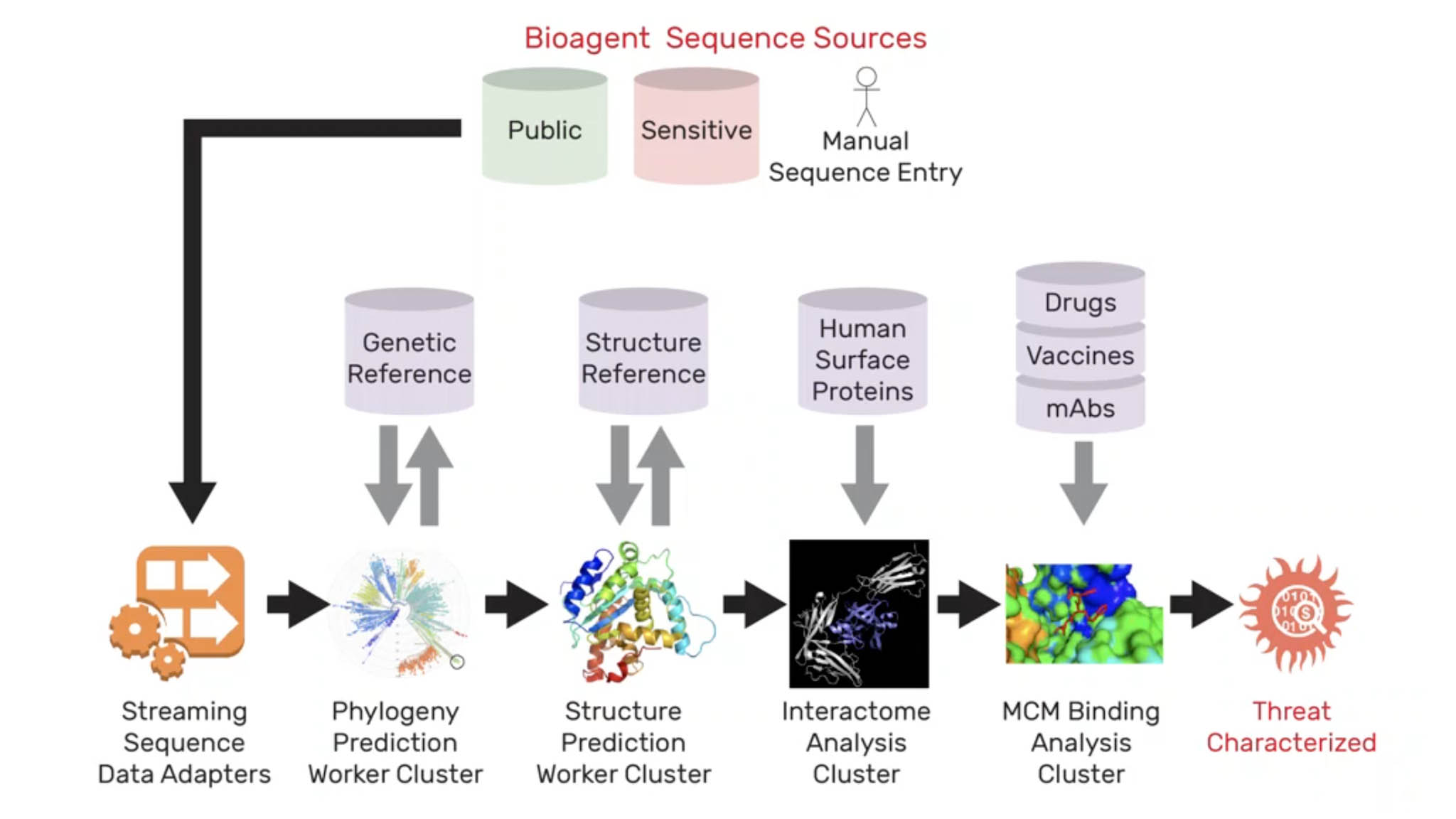
The ability to identify and characterize function of an unknown pathogen, such as a virus, bacteria, or toxin, from its biological sequence is critical to quickly determine the potential impact against human health. SEQer aims to build an end-to-end computational testbed that can stream biological sequences in real-time and determine their function to identify possible biothreats. To test the SEQer pipeline, we ran through an experiment investigating the interactions of SARS-CoV-2 with 67 different human cytokine proteins, a measure of infectivity.

In a paper published in Frontiers in Bioinformatics, we looked at 12 variants of concern of SARS-CoV-2 along with 5 other coronaviruses to evaluate the evolution of the viruses to infect humans. This combination of computational experiments (17 different viruses vs. 67 human proteins) resulted in a total of 1,139 simulations. We performed these simulations with a multi-threaded CPU-based algorithm on the Xeon Knight’s Landing platform with 64 physical cores assigned to each simulation. We also performed simulations with a competing single-threaded GPU-based algorithm using a single Nvidia V100 GPU per simulation.


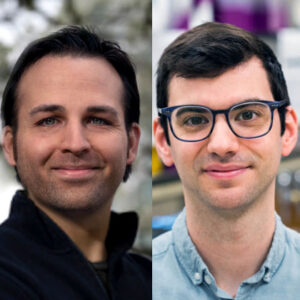
Rafael Jaimes, Phillip Tomezsko
Dr. Rafael Jaimes - Computational Biologist in the Biological & Chemical Technologies group at MIT Lincoln Laboratory.

Principal Members

Yale

Featured Projects

SC25 Project
A Safer Way to See Inside Cells
Accelerating Rendering Power
Adaptive Deep Learning Systems Towards Edge Intelligence
SC25 Project
AI for Cancer Diagnosis
SC25 Project
AI Pareidolia
SC25 Project
AI That Speaks Human About Health
Analyzing the Gut Microbiome
Asteroid Data Mining
SC25 Project
Better Pathogen Targeting
Bone Ratios and Big Data
Research Computing Center
BU Research Computing Services
SC25 Project
Building for Floods
Computation + Machine Intelligence | Wu Tsai Institute
Computational Modeling of Biological Systems
SC25 Project
Computing Hidden Health Threats from Heat
SC25 Project
CRISPR Mice, Smarter Science
Dancing Frog Genomes
Deciphering Alzheimer's Disease
Denser Environments Cultivate Larger Galaxies
Detecting Protein Concentrations in Assays
Developing Advanced Materials for a Sustainable Energy Future
Dexterous Robotic Hands
Discovering Evolution’s Master Switches
MGHPCC Project
Ecosystem for Research Networking
Electron Heating in Kinetic-Alfvén-Wave Turbulence
Ephemeral Stream Water Contributions to US Drainage Networks
Evaluating Health Benefits of Stricter US Air Quality Standards
Evolution of Viral Infectious Disease
Exact Gravitational Lensing by Rotating Black Holes
MGHPCC Project
Expanding Computing Education Pathways (ECEP) Alliance
SC25 Project
FlowER: AI for Predicting Chemical Reactions
Global Consequences of Warming-Induced Arctic River Changes
SC25 Project
Grid Responsive Data Centers
Research Computing Center
Harvard FASRC
SC25 Project
How Monkeys - and Machines - See in 3D
IceCube: Hunting Neutrinos
Impact of Marine Heatwaves on Coral Diversity
Investigating Mantle Flow Through Analyses of Earthquake Wave Propagation
Research Computing Center
Lincoln Laboratory Supercomputing Center (LLSC)
SC25 Project MGHPCC Project
Massachusetts AI Hub
SC25 Project MGHPCC Project
MGHPCC AI Computing Resource (AICR)
SC25 Project
Microplastic-Free by Design
MIT Brain and Cognitive Sciences
Research Computing Center
MIT Office of Research Computing and Data
Modeling Breast Cancer Spread
Modeling Hydrogels and Elastomers
Monte Carlo eXtreme (MCX) - a Physically-Accurate Photon Simulator
SC25 Project
Multifunctional 3D-Printed Materials
SC25 Project
Naval and Ocean Renewable Energy Hydrodynamics
Network Attached FPGAs in the OCT
Research Computing Center
NEU Research Computing
MGHPCC Project
New England Research Cloud
New Insights on Binary Black Holes
MGHPCC Project
Northeast Storage Exchange
Open Cloud Testbed
SC25 Project MGHPCC Project
OSN - Open Storage Network
Pulling Back the Quantum Curtain on ‘Weyl Fermions’
Quantum Computing in Renewable Energy Development
Revolutionizing Materials Design with Computational Modeling
SC25 Project
Sailing the Symbiosis Seascape
SC25 Project
Shining a Light on Dark Matter
Simulating Large Biomolecular Assemblies
SC25 Project
Social Capital and Economic Mobility
Software for Unreliable Quantum Computers
SC25 Project
Staving off the Banana Apocalypse
Studying Highly Efficient Biological Solar Energy Systems
SC25 Project
Supercomputers Reveal Ancient Atmospheric Battle
SC25 Project
Supporting Data-intensive Social Science
Surface Behavior
Taming the Energy Appetite of AI Models
The Institute for Experiential AI
The Kempner Institute - Unlocking Intelligence
MGHPCC Project
The Mass Open Cloud Alliance (MOC Alliance)
The US ATLAS Northeast Tier 2 Center
Tornado Path Detection
Towards a Whole Brain Cellular Atlas
SC25 Project
Tracking Environmental Health Risks
Research Computing Center
UMass - URI Unity Cluster
Research Computing Center
UMass Amherst Research Computing and Data
Research Computing Center
URI Institute for AI & Computational Research
Volcanic Eruptions Impact on Stratospheric Chemistry & Ozone
SC25 Project
Wrangle Range Modeling
Yale Budget Lab
Research Computing Center
Yale Center for Research Computing
SC25 Project
YARD: A Curation Workflow Tool
100 Bigelow Street, Holyoke, MA 01040