Welcome to the MGHPCC Virtual Booth

University of Massachusetts

Solving a Physics Mystery with Supercomputing

Using supercomputing, UMass Amherst researchers uncover evidence for a long-debated state of matter hidden within a classic physics model.

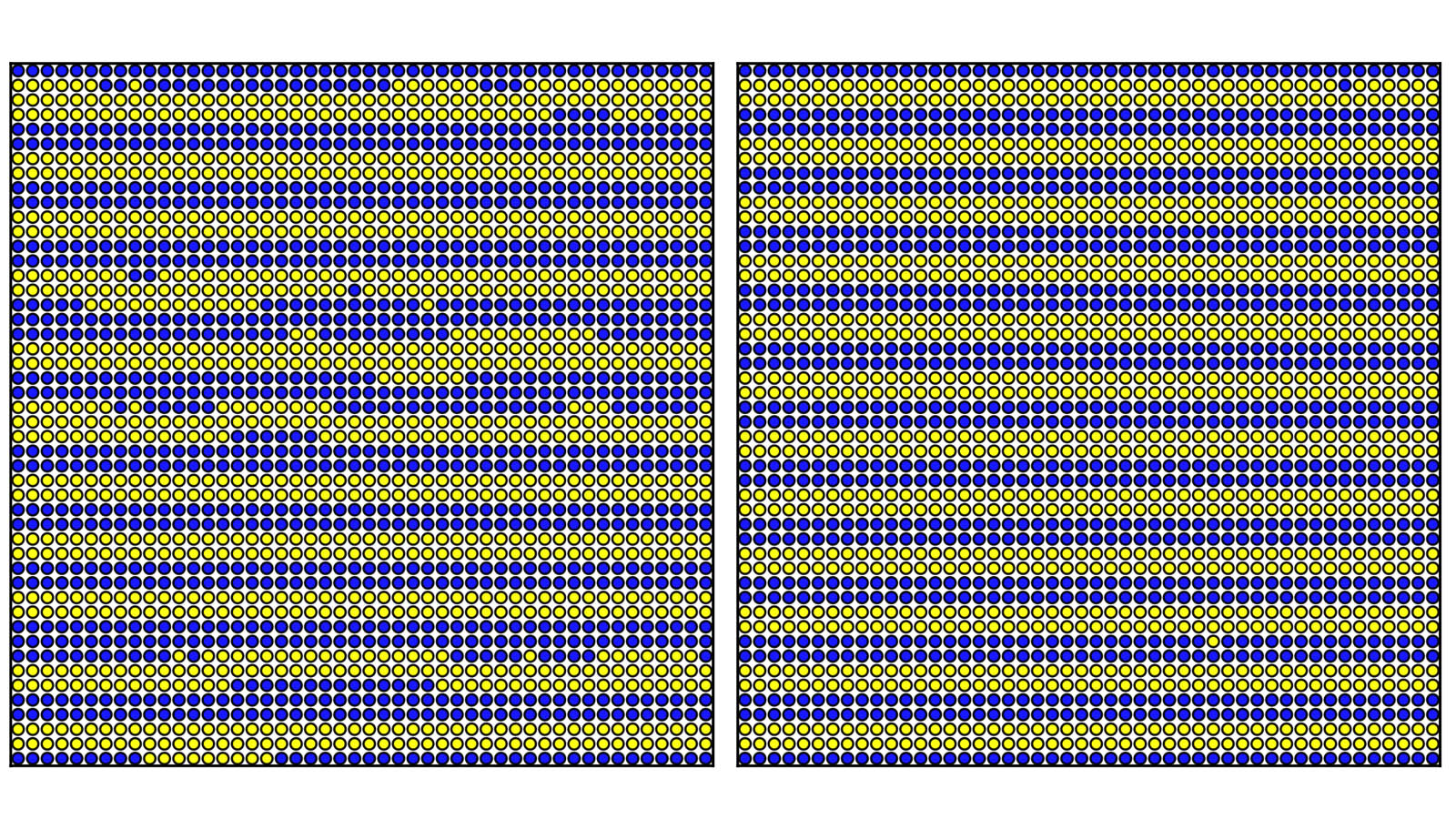
Scientists often use simplified computer models to understand how materials organize themselves at the atomic level. One such model, called the ANNNI model, has puzzled researchers for decades because it appears to pass through a strange intermediate state between being fully ordered and completely disordered. The challenge is that this state is extremely difficult to detect using conventional computer simulations, leaving scientists divided about whether it truly exists.

In this study, UMass Amherst researchers Shane Keiser and Jonathan Machta developed a powerful new computational method that allows computers to explore this complex system far more effectively than previous approaches. Rather than becoming trapped in a limited set of configurations, the new algorithm can efficiently navigate many possible arrangements, helping simulations reach more reliable results.

Using this technique, the pair carried out highly detailed simulations and uncovered strong evidence for the existence of the long-debated intermediate "floating" phase. Their work revealed subtle patterns and transitions that earlier studies could not clearly resolve, providing some of the clearest numerical support yet for this predicted state of matter.

Why does this matter? While the ANNNI model is an idealized representation of nature, it captures behaviors found in many real physical systems where competing forces create complex structures. The study demonstrates how advances in computing and simulation can help scientists tackle longstanding questions and uncover hidden features of the physical world.

This work is as much a computing breakthrough as a physics one. The researchers designed a new simulation algorithm and used large-scale numerical experiments to test it across thousands of temperatures and many different system configurations. The project required substantial computing power to run, compare, and analyze enormous numbers of simulations.

Publication

Keiser, S., & Machta, J. (2026), High Resolution Study of the 2D ANNNI Model Using a Two-replica Cluster Algorithm and Population Annealing, arXiv:2606.00882


Jonathan "Jon" Machta
Jonathan Machta’s research focuses on statistical physics, computational methods, and the behavior of complex systems. His work develops advanced simulation algorithms that help scientists understand how simple interactions can produce unexpected large-scale patterns in materials and other complex systems.

Principal Members

Yale

Featured Projects

A Cooler Quantum Future
SC25 Project
A Safer Way to See Inside Cells
Accelerating Materials Innovation with DFT, CALPHAD, and AI
Adaptive Deep Learning Systems Towards Edge Intelligence
SC25 Project
AI for Cancer Diagnosis
SC25 Project
AI Pareidolia
AI-powered Performance Analytics for HPC Systems
Asking Planetary Whatifs
SC25 Project
Better Pathogen Targeting
Research Computing Center
BU Research Computing Services
Building Bicontinuous Materials
SC25 Project
Building for Floods
Computation + Machine Intelligence | Wu Tsai Institute
SC25 Project
Computing Hidden Health Threats from Heat
Computing Ocean Carbon Removal
Computing the Geometry of Frustration
Dartmouth Chat
Developing Advanced Materials for a Sustainable Energy Future
From Murmurations to Music: Turning bird flight into climate stories
Generations of Discovery
Research Computing Center
Harvard FASRC
IceCube: Hunting Neutrinos
Imaging at Light Speed
Impact of Marine Heatwaves on Coral Diversity
Inside the Ocean's Response to Hurricanes
Learning Beyond Attention
Research Computing Center
Lincoln Laboratory Supercomputing Center (LLSC)
Mapping the Universe with AI and Supercomputing
Materials Remember
Materials That Give
SC25 Project MGHPCC Project
MGHPCC AI Computing Resource (AICR)
MGHPCC and Internet2
MGHPCC and Northern Crossroads
MGHPCC and the Campus Research Computing Consortium
MGHPCC and the IEEE High Performance Computing Conference
MGHPCC and the Massachusetts AI Hub
MGHPCC Project
MGHPCC and the National Data Platform
MGHPCC and the Northeast Research and Education Network
SC25 Project MGHPCC Project
MGHPCC and the Open Storage Network
MGHPCC Project
MGHPCC and the Prototype National Research Platform (PNRP)
MGHPCC Supercloud
SC25 Project
Microplastic-Free by Design
Research Computing Center
MIT Office of Research Computing and Data
Modeling an Atmospheric Detergent
SC25 Project
Multifunctional 3D-Printed Materials
SC25 Project
Naval and Ocean Renewable Energy Hydrodynamics
Research Computing Center
NEU Research Computing
SC25 Project
New Insights on Binary Black Holes
Northeast Storage Exchange
Precision Molecular Editing
Reading Night Light
SC25 Project
ReMIND
Revolutionizing Materials Design with Computational Modeling
Rhode Island INBRE Molecular Informatics Core (MIC)
SC25 Project
Sailing the Symbiosis Seascape
Seeing Ocean Currents with AI
SC25 Project
Shining a Light on Dark Matter
Simulating Large Biomolecular Assemblies
Smarter Protein Engineering
Software for Unreliable Quantum Computers
Solving a Physics Mystery with Supercomputing
SC25 Project
Staving off the Banana Apocalypse
Supercomputing the Arctic
SC25 Project
Supporting Data-intensive Social Science
The Kempner Institute - Unlocking Intelligence
The US ATLAS Northeast Tier 2 Center
Towards a Self-driving Lab?
Tracking Earth's Atmospheric Highways
Research Computing Center
UMass - URI Unity Cluster
Research Computing Center
UMass Amherst Research Computing and Data
Unlocking Non-coding DNA
Research Computing Center
URI Institute for AI & Computational Research
Virtual Materials Discovery at Scale
Watering MIT's AI Garden
SC25 Project
Wrangle Range Modeling
Yale Budget Lab
Yale Center for Genome Analysis (YCGA)
Research Computing Center
Yale Center for Research Computing
100 Bigelow Street, Holyoke, MA 01040